
Key Takeaways
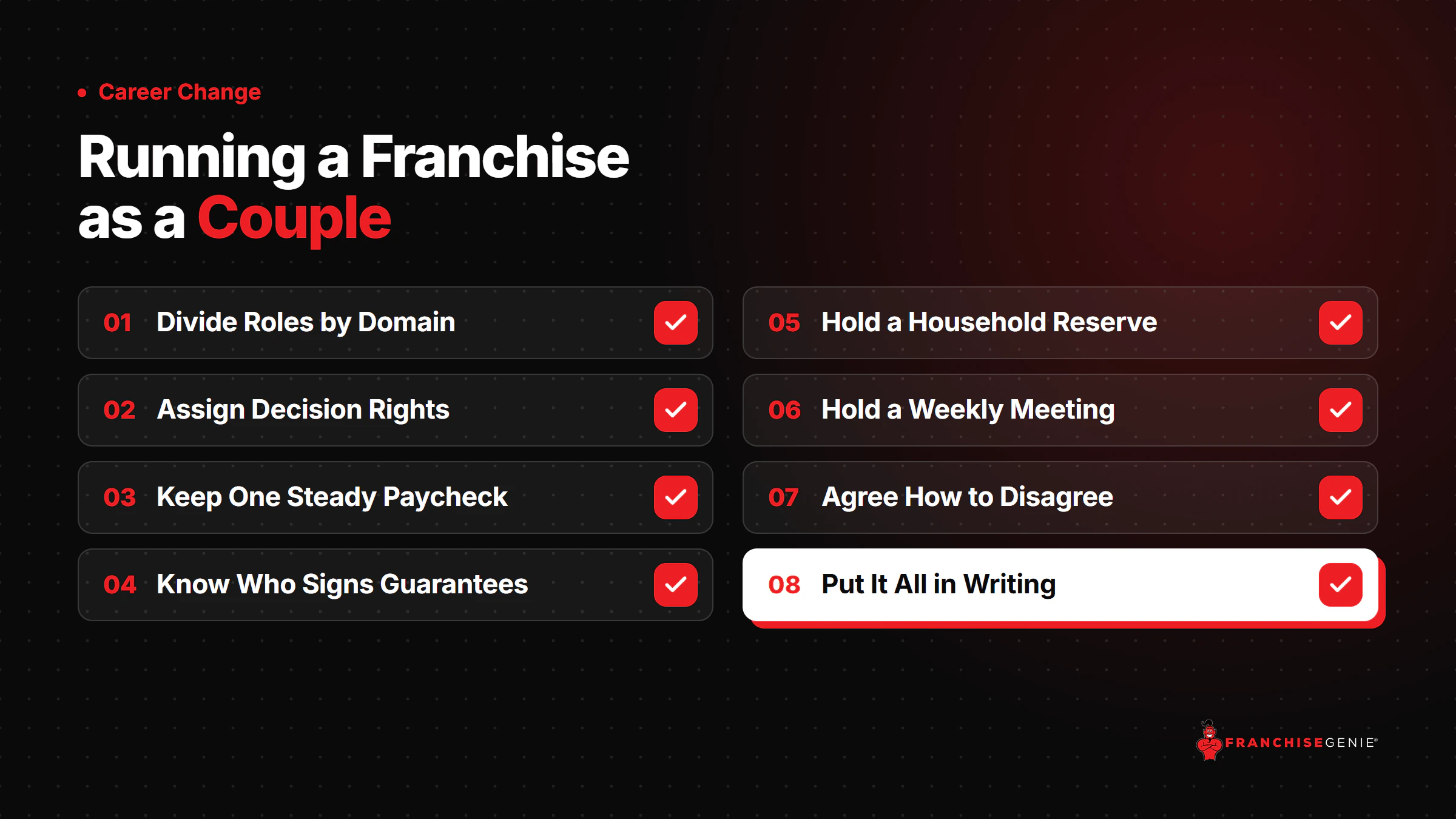
- A husband and wife franchise works best when each spouse owns a distinct set of responsibilities and final decisions in that area.
- Many couples reduce household risk by keeping one spouse's job and benefits while the other runs the business.
- Franchisors and lenders often ask both spouses to sign personal guarantees, so both partners share the financial exposure regardless of title.
- A written operating agreement should cover ownership percentages, decision rights, compensation, and what happens in a divorce, disability, or death.
A husband and wife franchise can be one of the strongest ownership structures in franchising when roles are clear, finances are protected, and the marriage has boundaries the business cannot cross. It can also concentrate every source of household risk into one company. The difference usually comes down to planning done before you sign.
Couples are drawn to co-ownership for good reasons. You already trust each other. Your skills may complement each other. And you share the same goal for the family’s future. Those advantages hold up only if you treat the partnership with the same structure you would demand from any business partner.
Why couples choose a husband and wife franchise
Franchising suits couples because the franchisor provides the operating system. You spend less time arguing about how things should be done, since the playbook already answers many of those questions. Your energy goes toward execution.
Common reasons couples buy together:
- Shared goals. Building equity, creating flexibility, or creating something to pass on.
- Complementary skills. One spouse is strong in operations, the other in sales or finance.
- Family involvement. Some couples want a business their children can work in and eventually own. That couple often fits The Family Founder or The Legacy Builder archetype.
- A career transition. One spouse is leaving corporate to buy a franchise, and the other wants a defined role.
How should spouses divide franchise duties?
Ambiguous roles cause more strain between co-owning spouses than almost anything else. When both people weigh in on everything, decisions slow down, employees get mixed messages, and small disagreements become personal.
Divide by domain, then hand over decision rights
Split the business into areas and give each spouse final say in theirs. A common division looks like this:
| Domain | Typical responsibilities | Who often fits |
|---|---|---|
| Operations | Scheduling, staff supervision, quality, customer issues | The spouse who prefers people and process |
| Growth | Local marketing, B2B sales, partnerships, community presence | The spouse who enjoys networking and selling |
| Finance and admin | Bookkeeping oversight, payroll, cash flow, vendor contracts | The spouse comfortable with numbers and detail |
| Hiring and culture | Recruiting, onboarding, training | Either, by agreement |
One spouse might own two areas. What matters is that both of you know who decides.
Separate the boss role from the partner role
Employees need one clear manager at a time. If one spouse runs daily operations, the other should route feedback through that spouse rather than redirecting staff on the floor. Disagreements happen privately.
Schedule business conversations
Many couples set a weekly business meeting with an agenda and protect the rest of the week from shop talk. Without that boundary, dinner becomes a staff meeting.
Should both spouses work in the business?
Not necessarily, and often not at first. Many couples keep one spouse in a salaried job through the launch and ramp. That paycheck covers household expenses, and employer health coverage removes one of the largest costs new owners face.
Three common structures:
- One operator, one employed. One spouse runs the franchise full-time. The other keeps a job and helps in a defined role, such as bookkeeping oversight or weekend marketing.
- Semi-absentee with a manager. Both spouses keep jobs, hire a general manager, and split 10 to 20 hours a week of leadership work. This needs more capital.
- Both full-time. Both spouses commit to the business. This maximizes control and household risk at the same time, and it requires the largest personal reserve.
If one of you recently lost a job, read our guide to buying a franchise after a layoff before choosing a structure.
How to protect your finances as a couple
Know who signs what
Many franchisors require both spouses to sign a personal guarantee of the franchise agreement, even if only one is listed as owner. SBA lenders generally require personal guarantees from significant owners. A commercial landlord may require one as well. Each guarantee puts personal assets behind the business. Have a franchise attorney explain what you are both signing.
Size capital for the household
Couples should look beyond the franchisor’s minimums. Our explainer on liquid capital requirements shows how franchisors evaluate cash, and our guide on how to finance a franchise covers SBA loans, home equity, and retirement rollovers. Then add a household reserve of 12 to 18 months of expenses, especially if both incomes depend on the business.
A hypothetical example
Consider a hypothetical couple, Tom and Rachel. Tom wants to leave his job to run a home services franchise. Rachel earns a stable salary with family health coverage. They agree that Rachel keeps her job for at least two years and handles bookkeeping oversight and payroll approval for about five hours a week. Tom owns operations, hiring, and sales. They hold a separate reserve equal to 15 months of the gap between Rachel’s take-home pay and household expenses. If the ramp takes longer than planned, the family still pays its bills.
Get the structure in writing
Most couples own a franchise through an LLC or corporation. Your operating agreement should cover:
- Ownership percentages
- Decision rights and how ties are broken
- Compensation for each spouse
- What happens if one spouse becomes disabled or dies
- What happens to the business in a divorce
- Whether either spouse can sell or transfer an interest
Discussing divorce while happily married feels awkward. It is far less awkward than resolving it later without a plan. A CPA can advise on tax structure and how to pay each spouse, and an attorney can draft agreements that reflect your state’s property laws.
How to protect the marriage
Running a business together changes a relationship. Couples who make it work tend to share a few habits.
- Define success together before you buy, in hours, money, and family time.
- Hold a weekly business meeting and keep the rest of the week mostly business-free.
- Keep separate spaces. Each spouse needs a part of life that is not the franchise.
- Agree on a disagreement process. Who decides, how long you discuss, and when you bring in an advisor.
- Check in on the relationship itself on a regular schedule, separate from the business.
Choosing a franchise as a couple
Use the same due diligence as any buyer, plus questions specific to couples.
- Ask the franchisor how many units are owned by couples, and call several.
- Ask those owners how they divide work and what they would change.
- Make sure both spouses attend discovery day and read the Franchise Disclosure Document, especially Items 7, 19, and 20.
- Remember that Item 19 is the only place a franchisor can legally share performance data. Nobody can tell you what your business will earn.
- Agree in advance on what would make either of you walk away.
If either spouse served in the military, ask about the IFA’s VetFran program, since some participating brands extend incentives to spouses, and explore SBA resources for veteran-owned businesses. Free mentoring through SCORE can also give you a neutral third voice when you disagree.
Couples in their 50s and 60s often approach co-ownership as a shared next chapter. Our guide to a franchise second career covers how experience, timing, and risk shift later in life.
Your next step
The strongest husband and wife franchises start with two people who agree on what they want before they agree on a brand. Answer the hard questions about roles, risk, and time first.
Our seven-question assessment can help. Each of you can take it separately, then compare your owner archetypes and industry matches to see where your goals overlap. When you are ready, take the free Franchise Genie assessment.
Frequently Asked Questions
Do both spouses have to sign the franchise agreement?
Not always as franchisees, but many franchisors require a spouse to sign a personal guarantee, even if that spouse holds no ownership. SBA lenders generally require guarantees from significant owners and may require spousal consent depending on state law and collateral. Ask each franchisor and lender exactly who must sign, and have a franchise attorney explain what each signature commits you to.
Should both spouses quit their jobs to run a franchise?
Usually it is safer for one spouse to keep a job, at least through the launch and ramp. A steady paycheck and employer health coverage reduce pressure on the business to produce income quickly. If both spouses leave, the household needs a larger cash reserve, often 12 to 18 months of expenses, on top of the business investment.
How should a married couple split ownership of a franchise?
Couples commonly hold the franchise through an LLC or corporation, with ownership split 50/50 or weighted toward the operating spouse. The right split depends on tax, liability, lending, and certification considerations, as well as state property law. Have a CPA and a franchise attorney recommend a structure and document it in a written operating agreement.
What is the biggest risk for couples who own a franchise together?
Concentration. When both incomes, the family savings, and the marriage all depend on one business, a slow quarter can strain everything at once. Couples manage this by keeping outside income where possible, holding a separate personal reserve, assigning clear roles, and setting boundaries so business conversations do not take over every evening.