
Key Takeaways
- Leaving corporate to buy a franchise works best when you choose an ownership model that matches how many hours you will actually give the business.
- Plan for the full investment, the franchisor's liquid capital requirement, working capital, and 12 to 18 months of personal living expenses before you resign.
- Leadership, financial literacy, and process discipline transfer well from corporate life, while reliance on support staff and slow decision cycles do not.
- FDD Item 19 is the only place a franchisor can legally share performance data, so build your projections from it and from conversations with current owners.
- Review your employment agreement, equity vesting, and benefits timeline before giving notice, and involve a franchise attorney and CPA before you sign anything.
Leaving corporate to buy a franchise can be a sound move for executives who have real capital, a realistic runway, and a clear picture of the role they want to play. The franchise model rewards the things corporate life trains well: process discipline, managing people, and reading financial statements. It punishes executives who skip due diligence, underestimate working capital, or buy a business that needs a different kind of owner than they are.
This playbook covers the decision from end to end. You will find how to judge which of your corporate skills will carry over, how to size your financial runway, how to pick an ownership model, when to give notice, and which traps catch experienced professionals most often. Each section links to deeper guides when you want more detail.
Is leaving corporate to buy a franchise right for you?
Start with motive. Executives usually arrive at franchising for one of four reasons: they want control over their time, they want to build equity they own, they feel stalled or unsafe in their company, or they have watched a peer do it. The first two are strong foundations. The last two are fine starting points, but they need more scrutiny, because a business bought to escape something tends to get evaluated less carefully than a business bought to build something.
Then look at your appetite for the parts of ownership that corporate life shields you from. In a franchise you sign a personal guarantee on the lease and often on the loan. Payroll comes out of your account whether or not revenue showed up. Nobody from IT, HR, or finance is down the hall. Some executives find that freeing. Others discover they liked having a support structure more than they realized.
A useful test is to answer three questions in writing:
- What do I want my average week to look like three years from now, in hours and in activities?
- How much capital can I commit without touching money I need for retirement or my family’s security?
- How long can my household go with reduced or no income from me?
If your answers are vague, you are early in the process, which is fine. If your answers conflict (say, 10 hours a week, a small budget, and a need for full replacement income within six months), that tension needs to be resolved before you look at any brand. Our guide to franchise owner personality walks through how temperament and goals shape which owner archetype fits you.
Which corporate skills transfer to franchise ownership?
Executives tend to overrate some of their skills and underrate others. The table below reflects how the work actually shifts.
| Corporate skill | Where it helps in a franchise | Where it can mislead you |
|---|---|---|
| Leading teams and managers | Hiring and coaching a general manager, building culture across units | Frontline hourly staff need a different, more hands-on style |
| Reading P&Ls and budgets | Tracking unit economics, labor percentage, cash flow | A small business runs on weekly cash, not quarterly forecasts |
| Following and improving processes | Executing the franchisor’s operating system faithfully | Rewriting the playbook usually violates the franchise agreement |
| Sales and client management | Local B2B selling, partnerships, referral networks | Consumer brands may need neighborhood marketing, not account management |
| Strategic planning | Multi-unit expansion, territory decisions | Day-one success depends on execution, not strategy decks |
| Delegation to support functions | Choosing good outside vendors (bookkeeper, CPA, attorney) | You will do many support tasks yourself early on |
The biggest adjustment is speed and scale. In a large company, a decision might take three meetings and a month. In a franchise, you might decide on a hire, a schedule change, and a local marketing spend before lunch, all with your own money. Executives who thrive tend to enjoy that compression.
The second adjustment is ego. Franchising is a system business. The franchisor has already decided the brand, the menu or service list, the software, and often the vendors. Your job is to execute that system extremely well in your market. If you are the person who always wants to redesign the process, an independent startup may fit you better than a franchise. Our comparison of a franchise vs starting your own business lays out that tradeoff.
How much financial runway do you need before you resign?
Executives often have more capital on paper than in cash. Stock awards, retirement accounts, and home equity all count differently, and lenders treat them differently. Build your plan around four separate buckets.
1. Total initial investment
This is the range listed in Item 7 of the Franchise Disclosure Document (FDD). It includes the initial franchise fee, build-out or equipment, opening inventory, training travel, and a working capital line the franchisor estimates for the first few months. Item 7 ranges can be wide, so price your specific market and site rather than taking the midpoint.
2. Liquid capital requirement
Franchisors set a minimum amount of cash or near-cash you must have, separate from your net worth requirement. This tells you how much the brand expects you to bring before financing. Our explainer on how to finance a franchise covers how lenders and franchisors look at liquidity.
3. Extra working capital
The franchisor’s estimate is a starting point. Many owners find that the ramp to break-even takes longer than planned, because of a slow lease negotiation, a permitting delay, or simply a slower customer build. A cushion beyond the Item 7 figure protects you from making desperate decisions in month eight.
4. Personal runway
This is the bucket executives miss most often. Many new franchise owners take little or no salary in the first year. Plan for 12 to 18 months of household expenses held separately from the business. Include health insurance, which is often the single largest surprise for people leaving a corporate plan. COBRA continuation, a spouse’s plan, or a marketplace policy all have very different costs.
A hypothetical runway calculation
Consider a hypothetical executive, Marcus, with $400,000 in liquid savings and a $600,000 401(k). He is considering a semi-absentee home services concept with an Item 7 range of $150,000 to $250,000. His household spends about $9,000 a month.
| Bucket | Amount he sets aside |
|---|---|
| Initial investment (upper end of Item 7 for his market) | $240,000 |
| Additional working capital cushion | $50,000 |
| Personal runway (15 months at $9,000) | $135,000 |
| Total | $425,000 |
Marcus comes up short on cash by $25,000, before any emergency fund. He has options: finance part of the investment with an SBA-backed loan, keep his job longer while a general manager runs the launch, use a 401(k) rollover structure, or choose a lower-investment model. Each option carries its own risk, and none of them is automatically right. The point of the exercise is to find the gap before he resigns. A CPA and an SBA preferred lender should review numbers like these before you commit. If you are weighing retirement funds, read our guide to ROBS franchise financing and get professional advice, since rollover structures carry specific compliance obligations.
What about income?
We will not tell you what you will earn, and you should be skeptical of anyone who does. Owner earnings depend on the brand, the market, your execution, your financing costs, and how you pay yourself. Averages hide enormous spread between top and bottom performers. The only place a franchisor can legally share performance data is Item 19 of the FDD, and not every franchisor provides one. Use Item 19 together with conversations with current franchisees to build your own projection.
Which franchise ownership model fits an executive?
The single most important decision you will make is your involvement level. It determines which brands make sense, how much capital you need, and what your days look like. Franchise Genie groups owners into nine archetypes across three involvement levels.
Owner-operator
You run the business day to day, at least at the start. This suits executives who want to be close to customers and staff and who need the business to replace their income relatively directly. In Franchise Genie terms, this is where The Full-Time Founder (trades the paycheck for ownership), The Empire Builder (masters one unit, then multiplies), The Lifestyle Operator, and The Family Founder live.
Semi-absentee
You hire a general manager to run daily operations and spend roughly 10 to 20 hours a week on leadership, hiring, finances, and local relationships. Many executives gravitate here because it uses their management skills and keeps time free. It usually requires more capital, since you are paying a manager’s salary from day one. Archetypes here include The Manager of Managers, The Portfolio Builder, The Freedom Architect, and The Legacy Builder. Our semi-absentee franchise guide explains how these models are structured and what they demand of you.
Passive or investor-led
You deploy capital into established, manager-run models and stay out of operations. This is The Hands-Off Investor. Fewer brands truly support this, and the ones that do often look for multi-unit commitments and significant capital.
Comparing the models
| Model | Typical owner hours | Capital needs | Best fit for |
|---|---|---|---|
| Owner-operator | Full-time, often more during launch | Lower to moderate | Replacing a salary through direct effort |
| Semi-absentee | Roughly 10 to 20 hours a week once stable | Moderate to higher | Leading managers, keeping time flexible |
| Passive / investor | Minimal | Higher | Capital deployment with oversight only |
Whichever you choose, verify it with current owners. A brand may call itself semi-absentee while most of its successful owners work full-time in year one.
Should you keep your job while you build the business?
This is one of the most practical decisions in the whole process, and it is underrated. Keeping your salary during the search, the build-out, and the first months of operation can dramatically reduce your risk. It also changes which models make sense, because an owner-operator concept cannot run on evenings and weekends.
Before you go this route, read your employment agreement for outside business activity clauses, conflict-of-interest policies, and intellectual property terms. Some employers require disclosure or approval. If your role touches the industry you are buying into, involve an attorney.
Some executives start with a smaller, lower-hour concept and build from there. Our article on the franchise side hustle explains which models tolerate limited hours and what the real time cost tends to be. Readers in this position should also see our guide on how to buy a franchise while working full-time.
When should you give notice?
Timing your exit from corporate is part of the financial plan. Work through these items before you set a date.
- Equity and bonuses. Map your vesting schedule, annual bonus payout date, and any deferred compensation. Leaving two months before a large vest can cost more than a delayed opening.
- Restrictive covenants. Non-compete, non-solicit, and confidentiality agreements can limit which industries you enter or whom you can hire. A franchise attorney can tell you how they apply.
- Benefits. Price health insurance before you resign, and check when your coverage ends.
- Financing timing. Lenders typically want to see your income and credit history. Some buyers secure financing approval before they leave employment. Ask your lender how employment status affects underwriting.
- The franchisor’s timeline. Training dates, site selection, and build-out often stretch several months. Your notice date should line up with when the business actually needs you.
If the decision has been made for you by a layoff, the math and the emotions change. Our guide to buying a franchise after a layoff covers how to use severance wisely and how to avoid rushing.
Special situations in the corporate-to-franchise move
Executives rarely fit one box. These situations come up often enough to warrant their own guides.
Veterans who moved into corporate roles
Many executives served before their corporate careers. Several franchisors participate in the International Franchise Association’s VetFran program, which offers incentives such as reduced initial fees, with terms that vary by brand. The SBA also maintains resources for veteran-owned businesses. Our full guide to franchises for veterans covers programs and fit.
Approaching or past retirement
If you are within a few years of retirement, protecting your nest egg becomes the first priority. A franchise for retirees needs a lower-stress model and a clear exit plan. Executives in their 50s who want one more meaningful chapter should read about the franchise second career.
Women leaving corporate leadership
Women executives bring the same transferable skills and face some distinct funding and networking questions. Our guide to franchises for women covers programs, networks, and ownership models.
Couples making the move together
When one spouse leaves corporate and the other keeps a job, or both commit full-time, the household risk profile changes completely. A husband and wife franchise works best with clearly divided roles and a written agreement.
Foreign executives and treaty investors
Executives from treaty countries sometimes use a franchise investment to qualify for an E-2 treaty investor visa. That path has strict rules and always requires an immigration attorney. Our E-2 visa franchise guide explains the requirements, and the USCIS E-2 page is the official reference.
The traps that catch experienced executives
Smart, accomplished people make predictable mistakes in this process. Most of them come from applying corporate habits in a setting where they do not fit.
- Choosing the brand before the role. An executive falls for a concept at a discovery day, then realizes later that it needs an owner on site 55 hours a week. Decide your involvement level first.
- Treating the FDD like a vendor contract. The franchise agreement is generally non-negotiable on core terms, and it binds you for 10 years or more in many systems. Read every item with a franchise attorney.
- Underfunding the ramp. Executives are used to budgets that get replenished. A small business that runs out of cash does not get a new allocation.
- Hiring a general manager like a corporate hire. A semi-absentee unit lives or dies on its manager. Pay for experience in that specific environment, and stay closely involved in the first year even if the model is labeled semi-absentee.
- Skipping validation calls. Current and former franchisees are listed in Item 20. Call many of them, including ones the franchisor did not suggest. Our list of franchise validation questions gives you a script.
- Over-indexing on brand recognition. A famous name can mean higher costs and saturated territories. An emerging brand can mean less proven support. Neither is automatically better.
- Ignoring personal fit with the work. If you dislike the customer, the product, or the type of employee the business hires, the business will feel like a job you bought.
- Expecting corporate-level support. Franchisor support teams can be excellent, but they serve many franchisees. You will solve most daily problems yourself.
How to evaluate a franchise like an executive
Your corporate experience is an advantage here, as long as you apply it rigorously. Treat the decision like a capital allocation with you as the operator.
Build a decision matrix
Before you look at brands, write your criteria and weights: investment ceiling, involvement level, industry interest, customer type (consumer or business), staffing model, and risk appetite. Score every option against the same matrix. This keeps a charismatic discovery day from overriding your plan.
Read the FDD in a structured order
Start with Item 7 (investment), Item 19 (financial performance, if provided), Item 20 (unit openings, closures, and transfers), Item 21 (franchisor financial statements), and Item 3 (litigation). Then read the franchise agreement itself. Our franchise disclosure document guide walks through each item.
Validate with owners at different stages
Talk to owners in their first year, owners with five or more years, and owners who left the system. Ask how many hours they actually work, how long it took to reach break-even, and whether they would buy again.
Get your advisors in place
You need a franchise attorney to review the agreement, a CPA to model the economics and structure the entity, and a lender if you are financing. Free mentoring through SCORE can add an experienced business owner’s perspective at no cost.
Pressure-test the downside
Model a scenario where revenue ramps 30 percent slower than your base plan. Can you survive it without new capital? If the answer is no, you either need more runway or a different model.
Is owning a franchise worth it for a corporate executive?
For the right person, ownership offers things a corporate career rarely does: equity you control, direct connection between decisions and outcomes, and a business you could eventually sell or pass on. The costs are real, too. You give up a predictable paycheck, take on personal guarantees, and accept royalties and system rules in exchange for the brand and playbook. Royalties commonly fall between 4 and 8 percent of gross sales, plus marketing fund contributions, and those fees come off the top every month.
Whether that trade makes sense depends on your goals, not on averages. Our honest look at whether owning a franchise is worth it works through the question from both sides, and our article on the pros and cons of owning a franchise goes deeper on the tradeoffs.
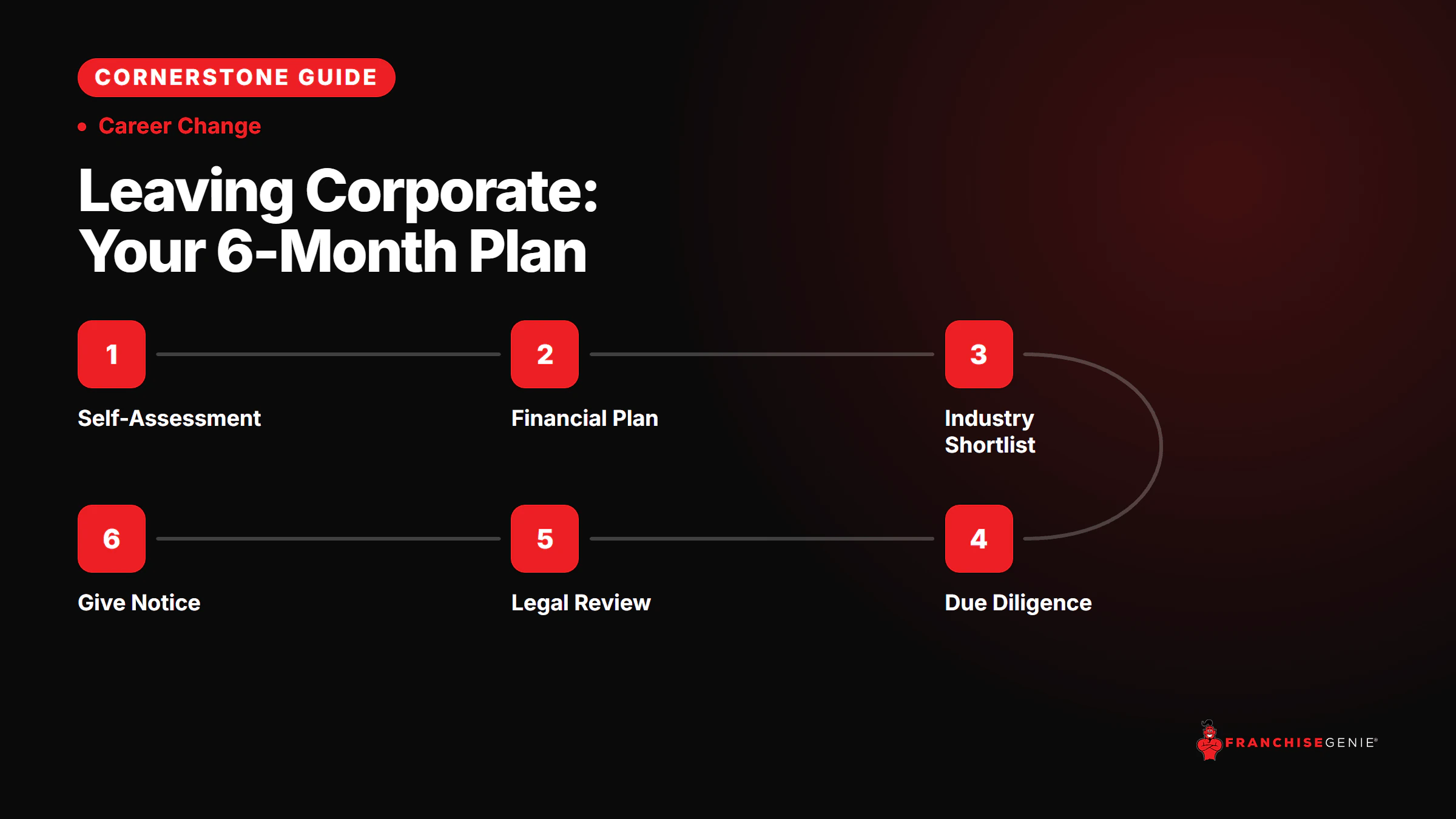
A six-month plan for leaving corporate to buy a franchise
Most corporate-to-franchise transitions take several months from first research to signing, and several more to opening. This sequence keeps your income in place for as long as possible.
| Month | Focus | Key actions |
|---|---|---|
| 1 | Self-assessment | Define goals, involvement level, budget, and risk tolerance. Take a structured assessment. |
| 2 | Financial plan | Size your four capital buckets with a CPA. Talk to a lender about pre-qualification. |
| 3 | Industry shortlist | Narrow to two or three industries that fit your criteria. Engage a consultant to identify brands. |
| 4 | Due diligence | Read FDDs, attend discovery days, run validation calls. |
| 5 | Legal and financing | Attorney review of the franchise agreement, financing approval, entity setup. |
| 6 | Decision and transition | Sign only after every item checks out, then set your notice date to match the training and opening timeline. |
Your timeline may be shorter or longer. What matters is the order. Self-assessment and financial planning come before brand shopping, and resigning comes last.
Your next step
The executives who make this transition well are the ones who start with themselves. Get clear on the role you want, the capital you can commit, and the risk you can carry, and the right industries narrow quickly.
That is exactly what our assessment is built to do. In seven questions, you get a Franchise Profile with your owner archetype, a match score, and three industry categories suited to your goals. A franchise consultant can then help you find specific brands. When you are ready, take the free Franchise Genie assessment and see which path fits the executive you want to become next.
Frequently Asked Questions
How much money should I have saved before leaving corporate to buy a franchise?
Plan for four buckets: the franchise's total initial investment from FDD Item 7, the franchisor's liquid capital requirement, extra working capital for the ramp-up period, and 12 to 18 months of personal living expenses. Many new owners take little or no pay in the first year, so the personal runway matters as much as the business budget. A CPA can help you size each bucket for your situation.
Can I buy a franchise without quitting my corporate job?
Often, yes. Semi-absentee models are designed for owners who hire a general manager and contribute roughly 10 to 20 hours a week, which some people manage alongside a job. Check your employment agreement for outside-business and conflict-of-interest clauses first, and confirm the franchisor allows semi-absentee ownership. Expect more hours during launch than once the business is stable.
Do franchisors prefer corporate executives as franchisees?
Many franchisors value candidates with management experience, financial literacy, and a track record of following processes, because those traits fit a system-based business. They also look for coachability. Executives who expect to redesign the brand's playbook can be a poor fit. Franchisors evaluate capital, credit, experience, and attitude together, and each brand sets its own criteria.
What is the biggest mistake executives make when buying a franchise?
The most common mistake is choosing a brand before defining the role they want. An executive who wants to lead managers can end up in a model that requires them behind a counter 60 hours a week. Decide your involvement level, budget, and risk tolerance first, then filter industries and brands against those criteria, and validate with current owners before signing.