
Key Takeaways
- Many franchisors participate in the IFA's VetFran program, but the size and type of veteran incentive varies by brand and should be confirmed in writing.
- A veteran discount on the initial franchise fee helps, yet the fee is usually a small share of the total investment, so judge the whole business first.
- The SBA offers veteran-focused training and counseling, including Boots to Business and Veterans Business Outreach Centers, at little or no cost.
- Military strengths such as following systems, leading teams, and executing under pressure map well to franchising, while local sales and marketing often need deliberate development.
Franchises for veterans are a strong match on paper. Many franchisors offer incentives through the International Franchise Association’s VetFran program, SBA resources help veterans prepare and finance a business, and franchise systems reward the discipline and leadership that military service builds. The best fit depends on your capital, the role you want, and the industry. The size of a discount should be one of the last things you weigh.
This guide covers the programs that exist, what discounts are actually worth, how military experience translates to ownership, and how to narrow your options without getting sold.
Why franchises for veterans make sense
A franchise is a business built on a documented system. You get an operations manual, a training program, approved vendors, and a support team. Veterans spent years inside systems with clear standards, chains of command, and checklists, so the culture of a well-run franchise tends to feel familiar.
Franchisors value that background, too. They want owners who follow the playbook, lead teams, and stay calm when things go sideways. Those traits are hard to teach, and they show up early when a unit is opening.
That fit is a starting point. It does not make every franchise a good franchise, and it does not mean every veteran should buy one. The decision still rests on capital, temperament, family situation, and goals.
What is the VetFran program?
VetFran is an initiative of the International Franchise Association that encourages member franchisors to offer incentives to veterans. Participating brands decide their own terms. Common incentives include:
- A reduced initial franchise fee
- Reduced or deferred fees in another category, such as training or technology
- Benefits extended to a military spouse in some systems
- Recruiting support for hiring other veterans as employees
Discounts vary widely by brand, and the program does not set a single standard offer. Ask every franchisor three questions: what exactly the incentive is, who qualifies (discharge status, spouses, reservists, Guard members), and whether it appears in writing in the franchise agreement or an addendum.
How much is a veteran discount really worth?
Keep the discount in proportion. The initial franchise fee is one line in the total investment shown in Item 7 of the Franchise Disclosure Document. Build-out, equipment, inventory, and working capital usually add up to much more.
Consider a hypothetical veteran, Andre, comparing two concepts. Brand A offers a generous veteran discount on its fee. Brand B offers a smaller one. If Brand B fits his budget, his schedule, and his local market better, the larger discount at Brand A is a poor reason to choose it. A discount saves you money once. A poor fit costs you every month.
SBA and other resources for veteran entrepreneurs
The SBA maintains a dedicated hub of resources for veteran-owned businesses. A few programs are especially useful when you are considering a franchise.
Boots to Business
This SBA entrepreneurship training is offered as part of the military’s Transition Assistance Program, with versions available to veterans and spouses after separation. It covers business fundamentals and helps you test an idea before you commit capital.
Veterans Business Outreach Centers
VBOCs provide counseling, training, and referrals for veterans, service members, and military spouses. A counselor can review a franchise business plan and point you to lenders familiar with veteran borrowers.
SBA-backed financing
Most franchise buyers who borrow use SBA-backed loans, typically the 7(a) program, through a bank or other approved lender. At various times the SBA has reduced or waived certain upfront fees for veteran borrowers. Policies change, so ask an SBA preferred lender what applies to your loan today. Our guide on how to finance a franchise covers the full set of options.
Free mentoring
SCORE offers free mentoring from experienced business owners and executives, many of whom are veterans themselves. A mentor who has run a small business can help you pressure-test a franchisor’s claims before you sign.
How military skills translate to franchise ownership
Veterans bring real advantages, and a few blind spots worth planning for.
| Military strength | How it helps in a franchise | Gap to plan for |
|---|---|---|
| Following standard procedures | Consistent execution of the brand’s system | Knowing when local conditions need adjustment within the rules |
| Leading small teams | Hiring, training, and holding staff accountable | Civilian hourly workers respond to different motivators and have more options |
| Logistics and planning | Scheduling, inventory, vendor coordination | Small-business cash flow is tighter than a unit budget |
| Composure under pressure | Opening weeks, staffing shortages, complaints | Long ramp periods test patience more than intensity |
| Mission focus | Driving toward clear goals | Local sales and marketing are often a new skill set |
The most common gap is selling. Many franchise models depend on local networking, B2B prospecting, or community marketing. If that work is unfamiliar, look for brands with strong marketing support, or plan to hire for it.
Which franchise models fit veterans?
There is no single best industry for veterans. The right model depends on how involved you want to be and what you want from the business.
Owner-operator models
If you want to lead from the front, owner-operator concepts put you in the business daily. Home services, commercial cleaning, and restoration often reward organized operators who can manage crews and schedules. These suit The Full-Time Founder and The Empire Builder, owners who master one unit and then grow.
Semi-absentee models
Veterans who are still serving, working a civilian job, or drawing a pension often prefer a model where a general manager runs daily operations. A semi-absentee franchise usually needs 10 to 20 hours a week from the owner once stable, and more capital at the start because you pay a manager from day one. This is the territory of The Manager of Managers and The Portfolio Builder.
Absentee or investor models
Some veterans with significant capital want minimal involvement. A true absentee franchise is rarer than marketing suggests, and the brands that support it often require multi-unit commitments. Verify the claim with current owners.
Retired veterans
If you retired from service with a pension and healthcare, your risk profile differs from a younger veteran’s. Our guide to choosing a franchise for retirees covers protecting your savings and choosing a lower-stress model.
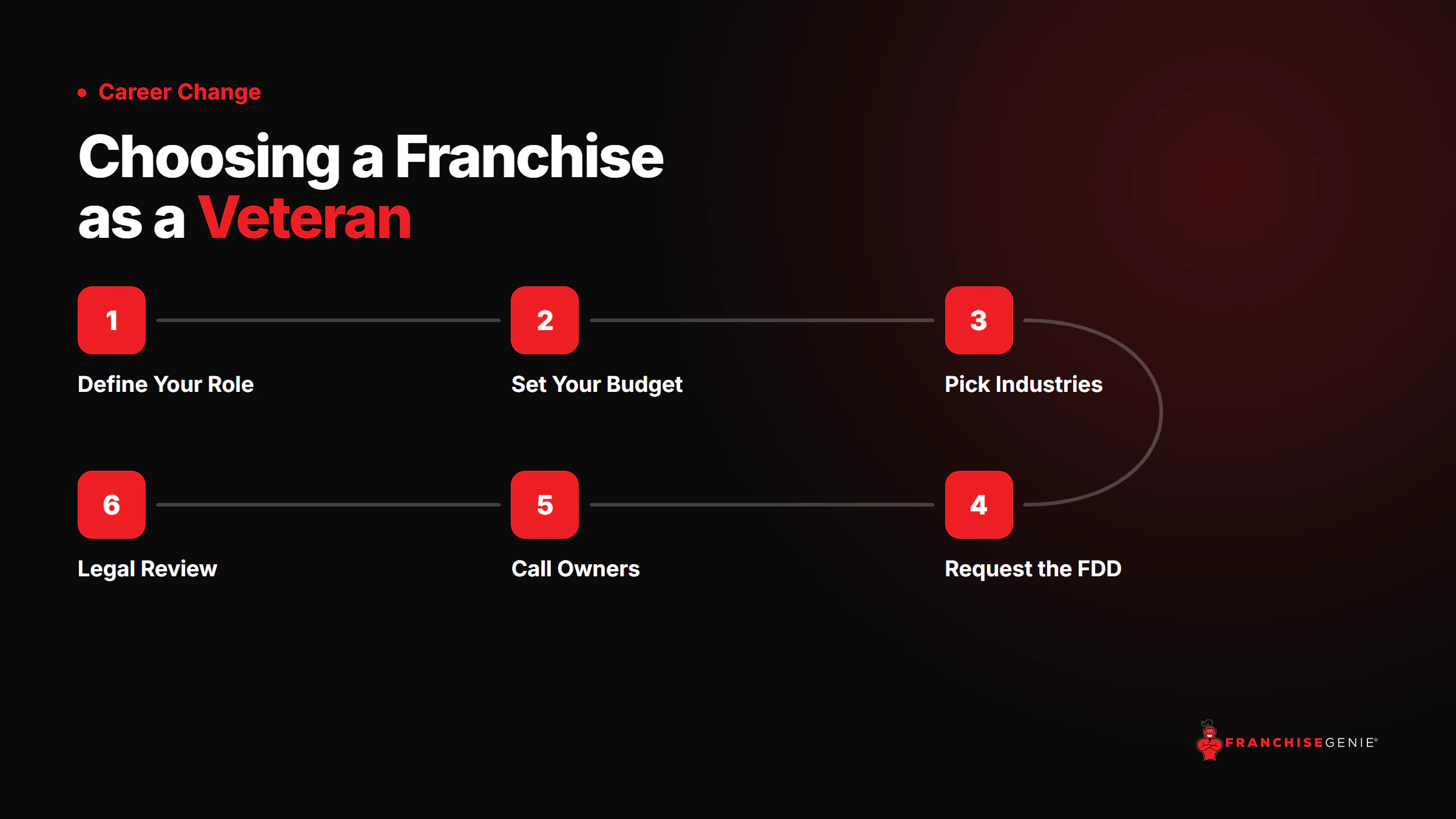
How to choose among franchises for veterans
A structured process protects you from choosing on enthusiasm or discount size.
- Define your role first. Owner-operator, semi-absentee, or investor. Write down the hours you will actually give.
- Set your budget. Include total investment, the franchisor’s liquid capital requirement, working capital, and 12 to 18 months of personal expenses.
- Shortlist industries before brands. Match industries to your skills and interests.
- Request the FDD. Read Items 7, 19, 20, and 21 closely. Item 19 is the only place a franchisor can legally share performance data, and not every brand includes one.
- Call owners, including veterans. Ask how the veteran incentive worked in practice and how many hours they really work.
- Hire a franchise attorney. Have the agreement and any veteran addendum reviewed before you sign.
If you also hold corporate experience, our playbook on leaving corporate to buy a franchise covers runway planning and timing your exit. Veterans who are not U.S. citizens and are exploring investment-based status should read our E-2 visa franchise guide and speak with an immigration attorney.
A word on income expectations
No franchisor, consultant, or article can tell you what you will earn. Owner income depends on the brand, your market, financing costs, and your execution. Averages hide wide differences between owners. Use FDD Item 19, when provided, and validation calls with current owners to build your own projections, and have a CPA review them.
Your next step
Your service already gave you discipline, leadership, and the ability to execute a plan. The open question is which kind of business puts those strengths to work on your terms.
Our assessment matches you to an owner archetype and three industry categories in seven questions, based on your goals, involvement, budget, and risk appetite. A franchise consultant can then help you find brands, including those that participate in VetFran. When you are ready, take the free Franchise Genie assessment.
Frequently Asked Questions
What is the VetFran program?
VetFran is a program of the International Franchise Association that encourages franchisors to offer incentives to qualified veterans. Participating brands set their own terms, which commonly include a reduced initial franchise fee. Some brands extend benefits to spouses or offer other perks. Because incentives vary by brand and can change, confirm the exact offer and eligibility rules with each franchisor before you rely on it.
Do veterans get special SBA loans to buy a franchise?
Veterans generally use the same SBA loan programs as other borrowers, such as 7(a) loans, which many franchise buyers use. At various times the SBA has reduced or waived certain upfront fees for veteran borrowers. Ask an SBA preferred lender what veteran benefits apply today, since policies change and eligibility depends on loan type and ownership structure.
Can I use my GI Bill or VA benefits to buy a franchise?
VA education and home loan benefits are not designed to fund a franchise purchase. Veterans typically finance a franchise with savings, SBA-backed loans, retirement rollovers, or franchisor financing. Separately, SBA programs such as Boots to Business offer free entrepreneurship training. Speak with a VA benefits counselor about your specific entitlements and a lender or CPA about financing options.
Are franchises a good fit for veterans with no business experience?
Franchises can suit first-time owners because they come with a tested operating system, training, and ongoing support. Veterans often adapt well to that structure. Lack of business experience still matters, especially in local marketing, hiring civilians, and managing cash flow. Choose a model whose training covers those gaps, and use free mentoring from SCORE or a Veterans Business Outreach Center.