Key Takeaways
- Buying a franchise after a layoff can be a smart move, but the decision should be made on a timeline you control, not on the emotion of the first weeks.
- Treat severance as personal runway first, because many new franchise owners take little or no pay in the first year.
- Health insurance, unemployment eligibility, and restrictive covenants should be resolved before you commit to a franchise.
- Running a job search in parallel with franchise research keeps your options open and reduces pressure to buy.
- A typical franchise purchase takes several months from first research to signing, which gives you time to make a deliberate decision.
Buying a franchise after a layoff can turn a setback into ownership, but only if you make the decision deliberately. Use severance as personal runway, give yourself a cooling-off period before any big commitment, and evaluate franchises with the same rigor you would if you were still employed. A layoff explains why you are looking. It should not decide what you buy.
Losing a job can feel like a door closing and a window opening at the same time. Many people who eventually become franchise owners trace the decision back to a layoff. Many others buy too fast, with money they needed, into a business that did not fit. This guide is about landing in the first group.
Is buying a franchise after a layoff a good idea?
It can be. A layoff often brings three things that make ownership more realistic: time to research, a lump of cash from severance, and a strong push to reconsider what you want from work. Those are real advantages.
The risks are just as real. People in the weeks after a layoff tend to be anxious about income and eager to regain control. Franchise sales processes, even honest ones, are designed to build momentum toward a signature. That combination leads some buyers to commit before they have done the math.
Ask yourself two questions honestly:
- Would I be seriously considering franchise ownership if I had not been laid off?
- If a comparable job offer arrived next month, would I still want to do this?
If both answers are yes, you are likely acting on a real goal. If both are no, you may be looking for relief from uncertainty, and a franchise is an expensive way to get it.
First steps in the 30 days after a layoff
Before you look at a single brand, stabilize your situation.
- Review your severance agreement. Note payment timing, benefits continuation, and any release you are asked to sign. An employment attorney can review it.
- Check restrictive covenants. Non-compete and non-solicit clauses can limit which industries you enter and whom you hire.
- Sort out health insurance. Compare COBRA, a spouse’s plan, and marketplace coverage. This is often a larger monthly cost than people expect.
- Apply for unemployment benefits. Then ask your state agency how self-employment would affect eligibility.
- Map your accounts. List cash, retirement accounts, home equity, and any stock or deferred compensation, and note which are truly accessible.
- Talk with your household. Ownership affects everyone who shares your finances.
How to use severance wisely
Severance is finite, and it disappears faster than most people expect. Before you think of it as investment capital, think of it as runway.
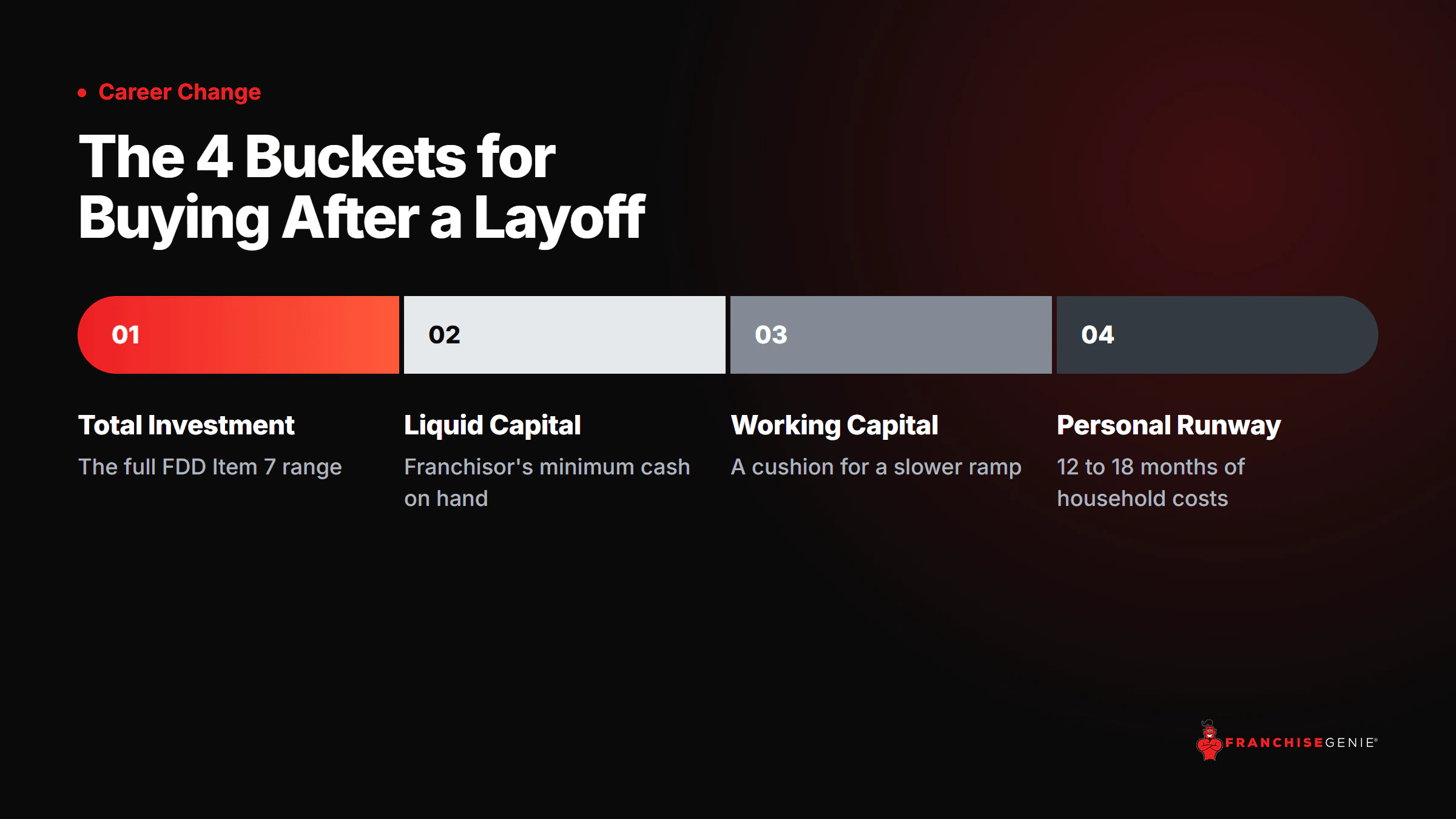
The four buckets
A franchise purchase needs money in four places:
| Bucket | What it covers |
|---|---|
| Total initial investment | The range in Item 7 of the Franchise Disclosure Document, including fees, build-out, equipment, and initial working capital |
| Liquid capital requirement | The minimum cash or near-cash the franchisor expects you to have |
| Extra working capital | A cushion for a slower-than-planned ramp to break-even |
| Personal runway | 12 to 18 months of household expenses, since many new owners take little or no pay in year one |
A hypothetical example
Consider a hypothetical laid-off operations director, Priya, who receives nine months of severance, about $110,000 after taxes, and has $150,000 in savings. Her first instinct is to put most of it into a concept with a $230,000 investment. When she separates the buckets, she sees that her household needs about $7,500 a month. Fifteen months of runway alone is $112,500, nearly all of her severance. That leaves about $150,000 for the business before financing.
Priya now has a clearer question. Can she find a model that fits $150,000 of equity plus an SBA-backed loan, or should she keep a job while a general manager runs a semi-absentee unit? Both are reasonable. Spending her runway on the down payment is not.
For a full breakdown of funding options, see our guide on how to finance a franchise.
Should you keep looking for a job at the same time?
In most cases, yes. Running a job search alongside franchise research does three useful things. It keeps income options open. It removes the pressure to buy because you feel you have no alternative. And it gives you a true comparison between two paths.
A new job does not have to end the franchise idea. Some buyers take a new role and then buy a model designed for limited owner hours. A semi-absentee franchise relies on a general manager for daily operations and typically needs 10 to 20 hours a week from the owner once stable. Our comparison of owner operator vs semi absentee models walks through how each affects your hours, capital, and risk.
Choosing a franchise after a layoff: avoiding emotional decisions
The emotional pull after a layoff is real, and it shows up in predictable ways.
Mistakes we see most often
- Buying to prove something. Wanting to show a former employer you are fine is understandable. It is a terrible criterion for a 10-year contract.
- Rushing because of a deadline the franchisor set. Legitimate franchisors give you time. Federal rules require that you receive the FDD at least 14 calendar days before you sign or pay. A brand that pressures you to skip steps is telling you something.
- Choosing the industry you just left. It feels safe, but check your non-compete and ask whether you actually want to keep doing that work.
- Treating a layoff as proof that employment is unsafe and ownership is safe. Ownership carries different risks, including personal guarantees and the chance of losing your investment.
- Skipping advisors to save money. A franchise attorney and CPA cost far less than a bad agreement.
Build a decision framework
Write your criteria before you meet any franchisor: maximum investment, hours per week, the type of work you want to do, the kind of customer you want to serve, and the level of risk you can live with. Score every opportunity against the same list.
When the timing is right, and when it is not
Signs the timing may be right:
- You have runway covering 12 to 18 months of personal expenses after funding the business.
- Your household agrees on the plan and the risk.
- You had been thinking about ownership before the layoff.
- You have read FDDs, talked with current owners, and still want to move forward.
Signs to slow down:
- The severance is the only cushion your household has.
- You feel urgency you cannot explain beyond “I need to do something.”
- You are unsure about health coverage or your non-compete.
- Your spouse or partner is hesitant.
If you and a spouse are considering running the business together after one of you was laid off, the household risk is even more concentrated. Our guide to the husband and wife franchise covers how couples divide roles and protect their finances.
Free help while you decide
SCORE offers free mentoring from experienced business owners and can help you test a business plan before you commit. If you served in the military, the SBA’s resources for veteran-owned businesses include counseling and training programs.
Be cautious of anyone who promises what the business will earn. Owner income varies widely by brand, market, and execution. Item 19 of the FDD is the only place a franchisor can legally share performance data, and not every brand provides one.
Special considerations by situation
- Corporate executives who were part of a restructuring often have larger severance packages and equity questions. Our playbook on leaving corporate to buy a franchise covers runway, timing, and ownership models in depth.
- Women returning to the workforce after a layoff can find funding programs and networks in our guide to franchises for women.
Your next step
A layoff can be the push that finally gets you to ownership. Make sure the business you choose would still make sense to you five years from now, once the layoff is a distant memory.
Our seven-question assessment helps you separate goals from emotion. It matches you with an owner archetype and three industry categories based on your involvement, budget, risk appetite, and timeline. When you are ready, take the free Franchise Genie assessment.
Frequently Asked Questions
Should I use my severance to buy a franchise?
Severance is usually best treated as personal runway, covering household expenses while the business ramps up, rather than as the down payment. New franchise owners often take little or no salary in the first year. If severance is your only cash, consider whether you can meet the franchisor's liquid capital requirement and still cover 12 to 18 months of living expenses. Review the plan with a CPA.
How soon after a layoff should I buy a franchise?
There is no fixed waiting period, but most people benefit from a cooling-off phase of several weeks before making any large financial commitment. Use that time to stabilize your finances, sort out health insurance, and define your goals. Franchise research and due diligence typically take several months anyway, so a measured pace rarely costs you an opportunity.
Can I get an SBA loan to buy a franchise if I was just laid off?
Possibly. Lenders look at credit history, the cash you can inject, collateral, relevant management experience, and the business plan. A recent layoff does not automatically disqualify you, but lenders will want to see how you will cover personal expenses during the ramp. Ask an SBA preferred lender how they view your situation before you choose a brand.
Will buying a franchise affect my unemployment benefits?
It can. Many states reduce or end unemployment benefits once you are self-employed or working full-time in your own business, and some have specific programs for self-employment. Rules vary by state, so check with your state unemployment agency before you sign a franchise agreement or begin operating, and factor the result into your runway.