Key Takeaways
- A franchise side hustle can work alongside a full-time job when the model is built around a general manager or limited, flexible owner hours.
- Expect the launch period to demand far more time than the steady-state hours a franchisor describes.
- Many franchisors require owner-operators, so confirm in writing that a brand accepts part-time or semi-absentee owners.
- Read your employment agreement for outside-business and conflict-of-interest clauses before you buy.
- Set clear criteria in advance for when the franchise could replace your salary, rather than deciding under pressure.
A franchise side hustle can work alongside your job, but only with the right model and a realistic view of the time it takes. Semi-absentee franchises run by a general manager and some flexible, home-based service models are designed for owners with limited hours. Most food, retail, and labor-heavy concepts are not. Expect the launch to take far more time than the steady state.
For many professionals, keeping a salary while building a business is the safest way into ownership. Income keeps flowing, benefits stay in place, and the business gets time to ramp without pressure to pay the mortgage in month three. The tradeoff is time, energy, and a model that has to run without you at the center.
Can a franchise side hustle really work with a full-time job?
It can, and many owners build businesses this way. Three conditions need to be true.
- The franchisor allows it. Many brands require an owner-operator who works in the business full-time. Others are built for semi-absentee owners. Confirm the policy in writing and in the franchise agreement.
- The business can run without you on site. That means a capable general manager or a model where your hours are flexible and can be scheduled around your job.
- Your employer allows it. Read your employment agreement for outside-business, conflict-of-interest, and intellectual property clauses. Some employers require disclosure or approval.
If any of the three is missing, you are buying a second full-time job.
Which franchise models fit limited hours?
Semi-absentee, manager-run
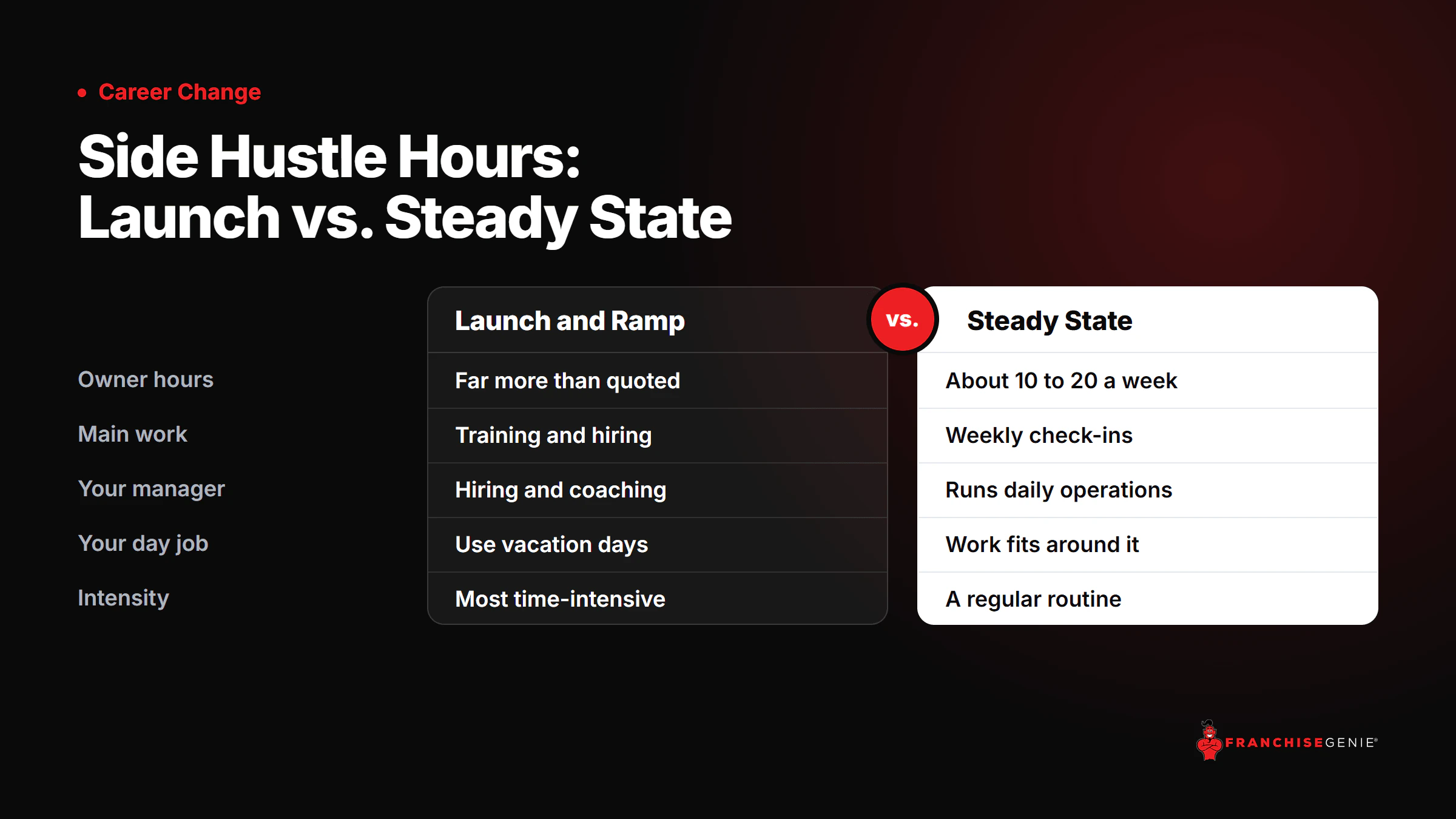
This is the most common structure for owners who keep their jobs. You hire a general manager who runs daily operations, and you handle leadership, hiring, finances, and local relationships. A semi-absentee franchise usually needs 10 to 20 hours a week from the owner once stable. It also needs more capital, since you pay a manager’s salary from the start.
Home-based and flexible service models
Some service concepts can be run from home with flexible scheduling. A home-based franchise often has lower overhead and no retail lease. Many still need the owner to sell, schedule, or do the work, so ask how much of the business you personally deliver.
Models that rarely fit a side hustle
| Model | Why it struggles as a side hustle |
|---|---|
| Quick-service and fast-casual food | Long operating hours, large teams, high labor management |
| Retail with fixed store hours | Staffing and opening hours often need owner coverage early on |
| Owner-delivered services | Revenue depends on the owner doing the work during business hours |
| B2B models built on owner selling | Prospecting happens during the business day, when you are at your job |
There are exceptions inside every category, which is why validation calls with current owners matter more than marketing materials.
What does a franchise side hustle really cost in time?
Franchisors describe steady-state hours. Your first year looks different.
The launch phase
Before opening, you will likely attend training (often one to several weeks, sometimes on-site at headquarters), review sites or territories, negotiate a lease if needed, hire your manager and team, and work through a grand opening. Many of these steps happen during business hours. Plan to use vacation days.
The ramp phase
In the first months after opening, you will review numbers weekly, coach your manager, fix early problems, and build local relationships. Owners often describe this phase as the most time-intensive of all.
Steady state
Once the business is stable and your manager is trusted, many semi-absentee owners settle into regular weekly check-ins, financial reviews, and periodic site visits. Hours vary by brand and by owner, so ask current franchisees exactly how they spend their time.
A hypothetical week
Consider a hypothetical owner, Jordan, an IT manager who owns a semi-absentee home services franchise in its second year. Jordan holds a 30-minute call with the general manager three mornings a week before work, reviews the weekly financial dashboard on Sunday evening, spends about three hours at a Saturday team meeting and a networking event, and handles a monthly session with the franchisor’s coach. That adds up to roughly 10 hours a week. In Jordan’s first six months, the same business took 25 to 30.
Money matters for side-hustle owners
Running a franchise on the side does not reduce the capital you need. You still need the total investment from Item 7 of the Franchise Disclosure Document, the franchisor’s liquid capital requirement, and working capital for the ramp. A manager-run model adds payroll for that manager from day one.
The upside of keeping your job is personal runway. Your salary covers household expenses, so the business does not have to pay you right away. That can let you reinvest early profits or ride out a slow ramp.
On earnings, be careful. Nobody can tell you what a franchise will make. Owner income depends on the brand, market, financing, and management. Item 19 of the FDD is the only place a franchisor can legally share performance data, and not every brand provides one. Check with a CPA on how business income or losses interact with your W-2 income for tax purposes.
Watch out for side hustle offers that are not franchises
Some programs marketed as side hustles, including certain vending, distribution, or online business packages, are business opportunities rather than franchises. They can have lighter disclosure requirements and less ongoing support. Our explainer on the franchise vs business opportunity distinction helps you tell them apart, and a franchise attorney can confirm what you are buying.
When does a side hustle become your main income?
Some owners keep the franchise as a side business indefinitely. Others eventually leave their jobs. Decide your criteria before you buy, so a great month does not push you out the door early.
Reasonable criteria include:
- The business has been consistently profitable for a period you define, after paying your manager.
- You have 12 to 18 months of personal expenses in reserve.
- The business has growth opportunities that need your full-time attention, such as a second unit.
- Your household agrees on the move, including benefits and health coverage.
When those are true, the playbook for leaving corporate to buy a franchise covers timing your exit, handling equity vesting, and planning the transition.
Who a franchise side hustle suits
- Professionals building equity who want ownership without giving up a salary yet.
- People in their 50s testing the waters before a full franchise second career.
- Veterans and service members in civilian jobs, who can use the SBA’s resources for veteran-owned businesses and ask brands about VetFran incentives.
- Investors who want a managed asset and will hold a manager accountable.
It suits people less well if they cannot get away from their jobs during business hours for the launch, if their employment agreement prohibits it, or if they would be uncomfortable trusting a manager with daily decisions.
Get perspective before you commit
Free mentoring through SCORE can help you pressure-test whether your schedule and budget support a side business. If you are still unsure whether ownership makes sense at all, our honest take on whether owning a franchise is worth it weighs the tradeoffs.
Your next step
A franchise side hustle works when the model, the franchisor’s policies, and your schedule all line up. Start with the hours you can really give and the capital you can commit.
Our seven-question assessment uses your involvement level, budget, and timeline to match you with an owner archetype and three industry categories. When you are ready, take the free Franchise Genie assessment and see which models fit around your current job.
Frequently Asked Questions
Can I own a franchise and keep my full-time job?
Yes, with the right model. Semi-absentee franchises use a general manager for daily operations, and some home-based or service models allow flexible owner hours. Many franchisors require full-time owner-operators, though, so confirm the brand's policy in writing. Also check your employment agreement for outside-business restrictions, and plan for a heavier time commitment during the first months.
How many hours a week does a part-time franchise take?
Semi-absentee models often settle into roughly 10 to 20 hours a week of owner time once the business is stable, covering leadership, hiring, finances, and local relationships. The launch period usually demands more, sometimes much more, for site selection, training, hiring, and opening. Ask current owners how many hours they worked in months one through six versus today.
What is the difference between a franchise side hustle and a business opportunity?
A franchise includes a licensed brand, an operating system, ongoing support, and a Franchise Disclosure Document regulated under the FTC Franchise Rule. Many products marketed as side hustles, such as some vending or distribution programs, are business opportunities with different, often lighter, disclosure requirements and less support. Read the documents carefully and have an attorney confirm which you are buying.
When should a franchise side hustle become my main income?
Set the criteria before you buy. Common ones include consistent profitability for a defined period, a personal reserve covering 12 to 18 months of expenses, a business that still needs your full attention to grow, and household agreement. Deciding in advance keeps you from leaving a job too early during a good month or staying too long out of fear.