Key Takeaways
- Franchise site selection weighs customer demographics, visibility and access, traffic patterns, co-tenants, competition, and total occupancy cost against the franchisor's site criteria.
- Most franchisors provide site criteria and must approve your location, but you usually sign the lease and carry the risk, so do your own analysis.
- Total occupancy cost, including base rent, common area maintenance charges, taxes, and insurance, matters more than base rent alone.
- Negotiate lease contingencies for franchisor approval, financing, and permits, and have a real estate attorney review the lease alongside the franchise agreement.
- Site selection and lease negotiation are often the longest single step between signing and opening for storefront concepts.
Franchise site selection is the process of finding a location that matches your franchisor’s criteria, reaches enough of the right customers, and carries an occupancy cost the business can support. The key factors are demographics, visibility and access, traffic patterns, co-tenants, nearby competition, and total rent. The franchisor typically approves the site, but you usually sign the lease and carry the risk.
For storefront concepts such as food, fitness, retail, and many wellness models, location is one of the few decisions you cannot easily undo. A weak menu item can be replaced. A weak site, locked in by a 10-year lease, stays with you. That is why site selection deserves the same rigor as reading the disclosure document.
This guide covers who does what, which data matters, and how to avoid common lease mistakes. It fits into the larger sequence of steps in our guide on how to buy a franchise.
Does your franchise need a site at all?
Not every franchise needs a storefront. Many home services and B2B services models run from a home office, a shared workspace, or a small warehouse unit for vehicles and equipment. For those, “site selection” is mostly about your territory: its size, population, and the customers within it.
| Model type | Site needs | What matters most |
|---|---|---|
| Home-based or mobile services | Home office, maybe storage | Territory demographics and size |
| Office-based B2B services | Modest office space | Access for staff, proximity to clients |
| Retail and personal services | Storefront in a strip or neighborhood center | Visibility, parking, co-tenants |
| Fitness and wellness | Larger storefront, specific layout | Demographics, parking, evening and weekend access |
| Food and beverage | Specific footprint, venting, drive-thru for some | Traffic, visibility, access, daytime population |
If you are still choosing between models, real estate needs are a useful filter. When you compare franchises, factor in the time and cost a build-out adds.
Who does what in franchise site selection?
Roles vary by brand. Item 11 of the franchise disclosure document describes the franchisor’s obligations, including any site selection help and the time limit for approving or rejecting a proposed site. Common arrangements include:
- Franchisee-led with franchisor approval. You find sites, often with a commercial broker, and submit them for approval. This is the most common model.
- Franchisor-assisted. The franchisor provides demographic reports, a site criteria package, or a preferred real estate broker.
- Franchisor-selected. Less common, and usually found in systems with a dedicated real estate team.
Whatever the arrangement, read the franchise agreement carefully. It may set a deadline to secure a site, and missing it can have consequences. It may also require the franchisor’s approval of the lease itself, often with specific clauses the landlord must agree to.
What data matters in choosing a location?
Franchisors usually provide a site criteria profile. Use it as a minimum standard, then do your own analysis.
Demographics
Who lives and works within a reasonable drive time? Look at population, household income, age, household composition, and daytime population. A business serving young families needs different demographics than one serving retirees or office workers. Your franchisor should tell you which customer profile drives its business.
Visibility and access
Can drivers see the sign in time to turn in? Is the entrance easy to reach from both directions of traffic? Is parking adequate at peak hours? Sites on the “going home” side of a commuter road often suit evening businesses better than sites on the “going to work” side.
Traffic patterns
Traffic counts tell you how many cars pass, but not whether they stop. Visit the site at the hours your business will be busiest: weekday mornings for coffee, evenings and Saturdays for fitness, lunch for fast-casual. Count cars in the lot. Watch where people walk.
Co-tenants and anchors
Neighboring businesses shape your traffic. A grocery anchor draws frequent, repeat visits. Complementary co-tenants can help. A center with high vacancy can signal problems.
Competition and saturation
Map direct competitors and other units of your own brand. Some competition confirms demand. Too much splits it. Check whether your territory protections, described in Item 12, actually prevent another unit from opening nearby.
Occupancy cost
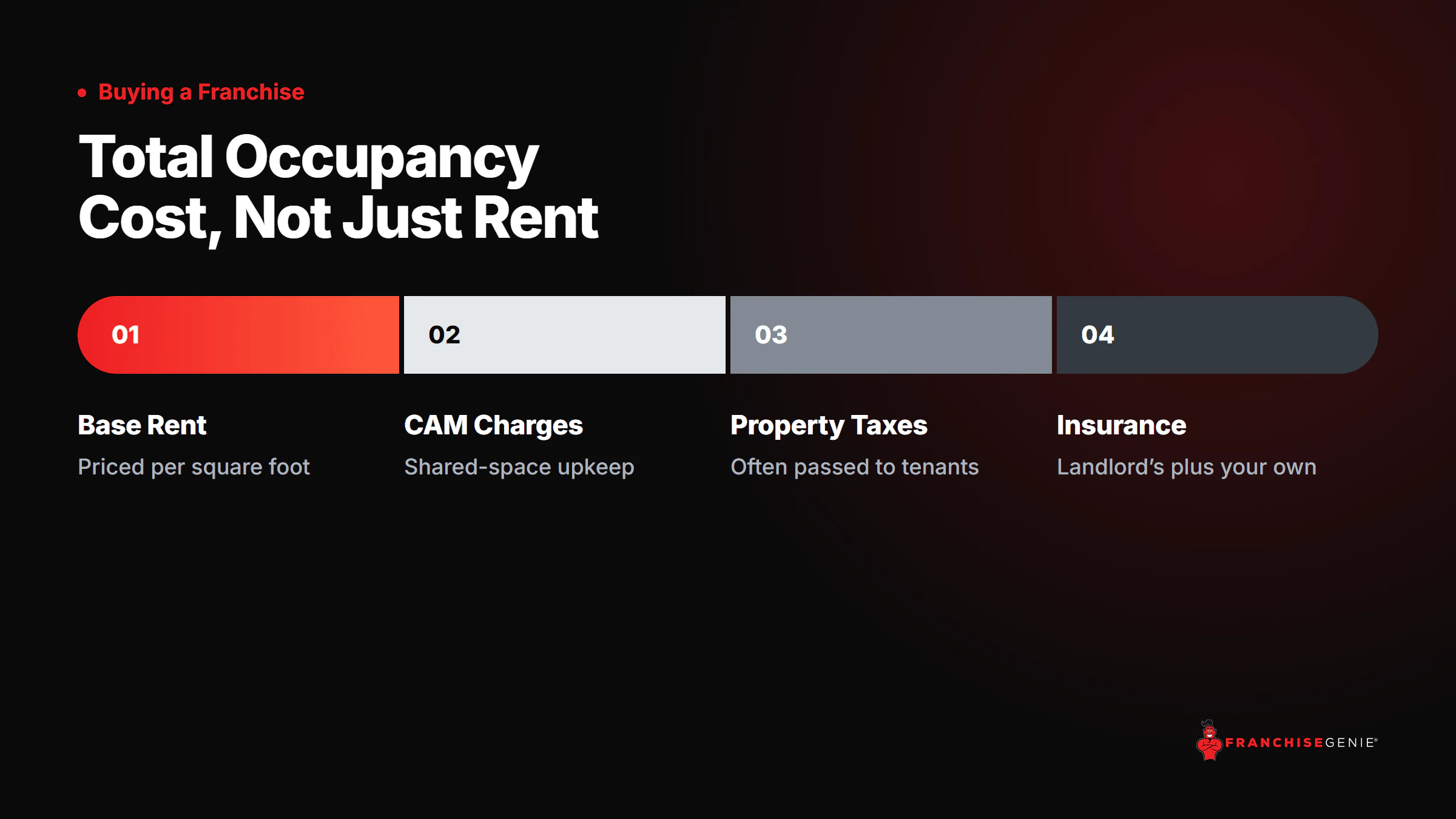
Rent is often one of the largest fixed costs in a storefront business. Look at total occupancy cost, not just base rent.
| Cost component | What it is |
|---|---|
| Base rent | Fixed monthly rent, usually priced per square foot per year |
| Common area maintenance (CAM) | Your share of parking lot, landscaping, and shared space upkeep |
| Property taxes | Often passed through to tenants |
| Insurance | Landlord’s property insurance passed through, plus your own policies |
| Annual escalations | Scheduled rent increases, often a fixed percentage each year |
| Percentage rent | Additional rent based on sales above a threshold, in some leases |
Ask current franchisees with similar sites how occupancy costs compare to their sales, and have your accountant model rent against conservative revenue assumptions. A great location that costs too much can still sink the business.
The franchise site selection process, step by step
- Get the franchisor’s site criteria and ask which recent sites have performed best and why.
- Hire a tenant-side commercial broker who works for you, not the landlord. In many markets, the landlord pays the broker’s commission.
- Build a shortlist of 3 to 5 sites that meet the criteria.
- Visit each site at multiple times of day and week.
- Submit sites for franchisor approval with the data they require.
- Negotiate a letter of intent covering rent, term, tenant improvement allowance, free rent period, and contingencies.
- Have a real estate attorney review the lease, alongside your franchise attorney.
- Sign the lease only once financing, permits, and franchisor approval are secured or covered by contingencies.
Lease pitfalls to avoid
Most site selection regrets come from the lease rather than the location.
- No contingencies. Make the lease contingent on franchisor approval, financing, and permits where possible, so you are not bound to rent a space you cannot use.
- A term that doesn’t match your franchise agreement. If your franchise term is 10 years and your lease is 5 with no renewal option, you may lose your location mid-term.
- Weak exclusivity. Ask for a clause that prevents the landlord from leasing to a direct competitor in the same center.
- Unlimited personal guarantee. Try to cap it by amount or time.
- Underestimated build-out costs. Get a contractor’s estimate before you sign, and understand what the landlord’s tenant improvement allowance covers.
- No assignment rights. If you might sell the franchise later, the lease must allow assignment to an approved buyer.
Your franchisor may require specific lease provisions, such as the right to take over the lease if your franchise ends. Read these alongside the rest of your agreement.
It is also worth checking whether real estate has been a source of conflict in the system. Item 3 of the FDD discloses certain litigation, and our guide to FDD litigation history explains how to read it for patterns such as territory or encroachment disputes.
A hypothetical example
Consider a hypothetical buyer, Tom, opening a boutique fitness studio. His franchisor approves two sites. Site A sits in a busy center with a grocery anchor and higher rent. Site B is cheaper but tucked behind a bank with limited signage.
Tom visits both at 6 a.m. and 6 p.m. on weekdays and on a Saturday morning. Site A’s lot is busy during his class hours. Site B’s lot is nearly empty after the bank closes. His accountant models both sites using conservative membership assumptions and finds that Site A’s higher rent is supportable if membership ramps at the pace owners described in validation calls. Tom negotiates a free-rent period during build-out and a permit contingency, then signs for Site A.
This is an illustration only. The right choice in your market depends on your own data and advisors.
Site selection affects your timeline
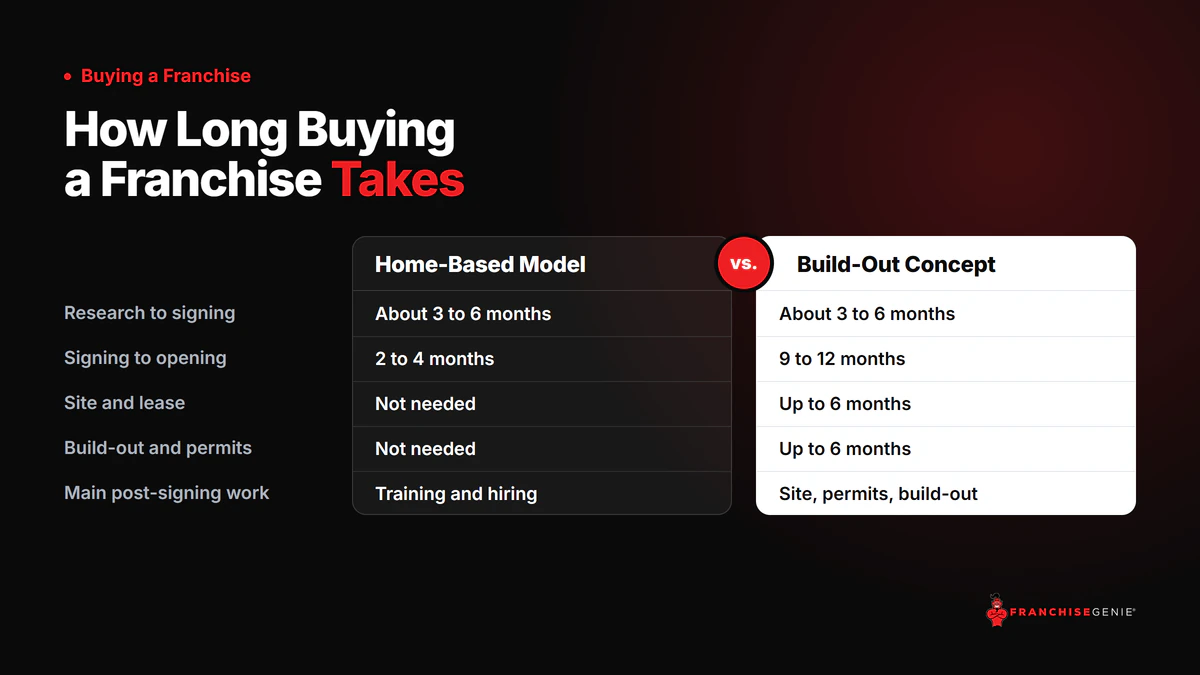
For build-out concepts, site selection and leasing often take longer than anything else between signing and opening. Your franchise agreement may set an opening deadline. Ask the franchisor how long recent franchisees in comparable markets took to secure a site.
Once your lease is signed, the next phases are build-out, hiring, and franchise training. The SBA’s guide to buying a business or franchise is a useful reference on financing considerations, and the FTC’s Consumer’s Guide to Buying a Franchise covers questions to ask about the franchisor’s role in site support.
Choose the right model first
The best site in town won’t help if the business itself doesn’t fit you. Before you start looking at storefronts, make sure the model matches your budget, schedule, and goals. Take the free Franchise Genie assessment to get an owner archetype and three industry categories matched to your answers, including whether a storefront model suits you at all.
Frequently Asked Questions
Who chooses the location for a franchise, the franchisee or franchisor?
In most systems, the franchisee finds and secures the site, and the franchisor approves it against its criteria. Some franchisors provide real estate support, demographic reports, or a preferred broker, and a few select sites themselves. Item 11 of the FDD describes the franchisor's role in site selection. Even with franchisor approval, you typically sign the lease personally or through your entity, so the risk sits with you.
How long does franchise site selection take?
For storefront concepts, finding, approving, and leasing a site commonly takes 2 to 6 months, and longer in tight retail markets. Build-out and permitting then add several more months. Franchise agreements often set an opening deadline, so ask how long site selection has taken for recent franchisees in markets like yours and build that into your plan before you sign.
Does franchise approval of a site mean it will succeed?
No. Franchisor approval means the site meets the brand's minimum criteria. It does not guarantee customer traffic or sales, and franchisors generally make no promises about performance at any location. Treat approval as one check among several. Do your own research on demographics, competition, access, and occupancy costs, and talk to franchisees with similar sites about how they perform.
What is a personal guarantee on a commercial lease?
A personal guarantee makes you personally responsible for lease obligations if your business cannot pay. Landlords often require one from new businesses without an operating history. You may be able to limit it, for example to a set number of months of rent or a declining amount over time. A real estate attorney can advise on what is realistic in your market.