Key Takeaways
- To compare franchises fairly, score every brand on the same criteria using the same sources, mainly the FDD and conversations with franchisees.
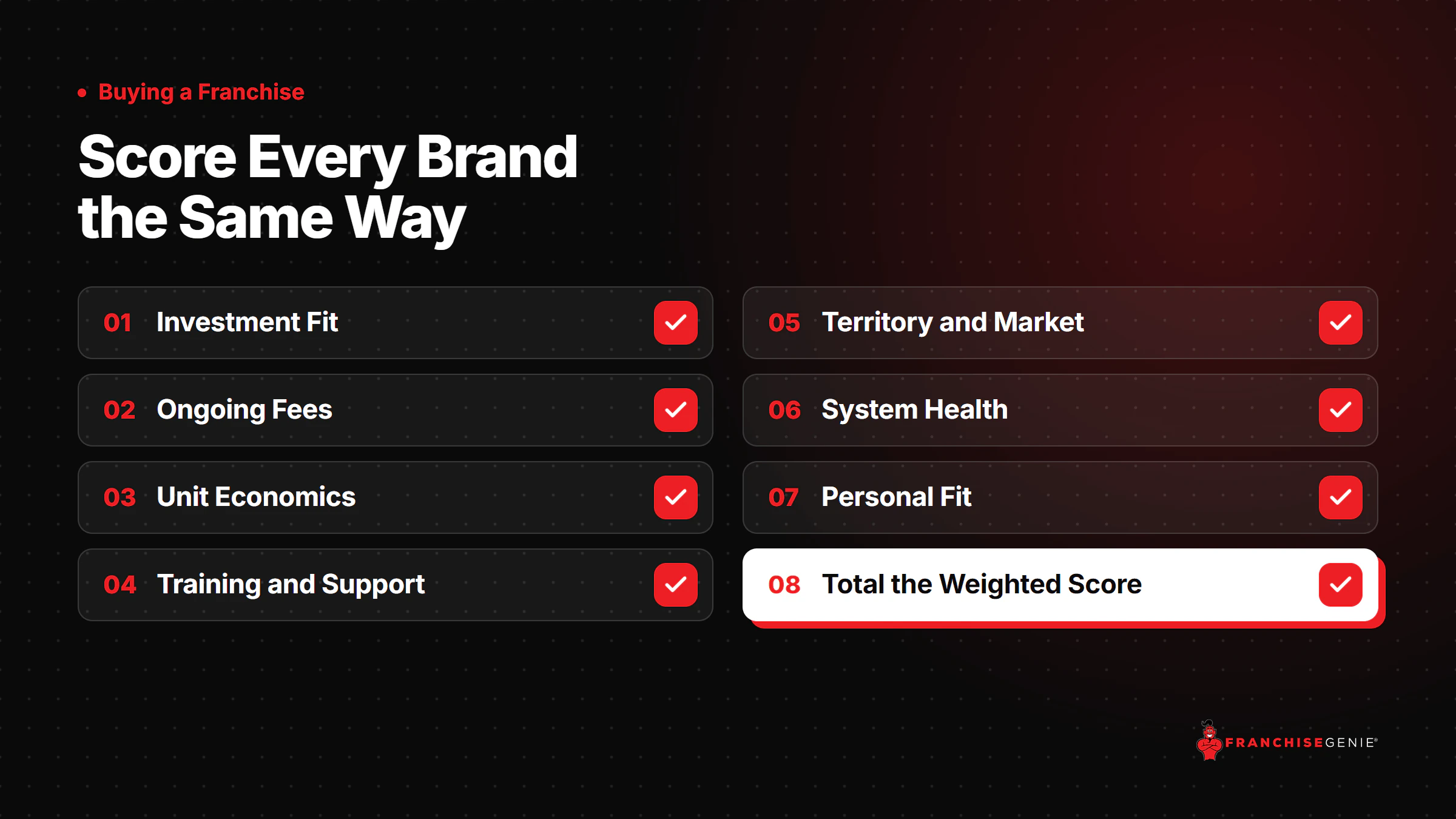
- A weighted scorecard lets you rate each brand from 1 to 5 on criteria such as investment fit, unit economics, support, territory, system health, and personal fit, then multiply by weights that reflect your priorities.
- Personal fit and franchisee validation deserve heavy weight, because a strong brand that doesn't suit your schedule or skills is still the wrong choice.
- Compare the full investment from Item 7, including working capital, instead of the franchise fee alone.
- Use the scorecard to structure your judgment, then check close results against your gut and your advisors.
To compare franchises side by side, score each brand on the same set of criteria, using the same sources, and weight those criteria by what matters most to you. A weighted scorecard covering investment fit, unit economics, support, territory, system health, and personal fit turns a pile of notes into a clear ranking. The copyable scorecard below takes about an hour per brand once your research is done.
Most buyers compare franchises by impression. One brand had a great discovery day, another had a slick website, and a third has a product they love as a customer. Impressions matter, but they are easily shaped by sales skill. A structured comparison makes you look at the same facts for every brand and decide in advance how much each fact counts.
This guide shows you what to compare, where to find the information, and how to build your scorecard. For the full set of buying steps around it, see our guide on how to buy a franchise.
Before you compare franchises, narrow your industries
A scorecard works best when it compares like with like. Comparing a mobile lawn care franchise with a sit-down restaurant on “total investment” tells you very little, because they are different businesses with different labor, hours, and risks.
Start by narrowing to two or three industries that match your budget, involvement, and goals. Then shortlist 3 to 5 brands within them. If you are still at the industry stage, our overview of the types of franchises is a good starting point.
What to compare: the seven criteria that matter
These criteria cover what most buyers need. You can rename or add rows, but try not to drop any of them entirely.
1. Investment fit
Compare the full estimated initial investment from Item 7 of each FDD, not just the franchise fee. Include the “additional funds” line for working capital. Then compare that total against your actual liquid capital and financing capacity. A brand at the top of your budget, with little cushion, should score lower than one that leaves you a reserve.
Also note large equipment or vehicle requirements. Some can be financed separately, which changes your cash needs. Our guide to franchise equipment financing explains how that works, and our cornerstone on how to finance a franchise covers the broader options.
2. Ongoing fees and cost structure
Compare royalty rates, marketing fund contributions, technology fees, and any required vendor programs from Items 5 and 6. A royalty of 6 percent of gross sales and one of 8 percent are not hugely different on their own, but combined with other fees they shape your margin for a decade.
3. Unit economics and financial disclosure
Look at whether each brand includes an Item 19 financial performance representation, what it covers, and how it was calculated. Note which units are included and which costs are excluded. Then use validation calls to understand how costs like labor and rent behave in practice. You are comparing the quality and transparency of the information, as well as the figures themselves. Never treat Item 19 as a forecast of your own results.
4. Training and support
Compare the length and content of initial training (Item 11), the ratio of field support staff to franchisees, and what owners say about support after opening. This is where validation calls carry the most weight.
5. Territory and market
Compare territory size, how it is defined, whether it is exclusive, and what exceptions apply (Item 12). Consider your specific market: is there room for the business, and how many competing units are nearby? For storefront concepts, availability of suitable real estate matters here too. Our guide to franchise site selection covers what to evaluate.
6. System health
Use Item 20 to compare openings, closures, terminations, and transfers over the past three years. Check Item 3 for patterns of franchisee litigation and Item 21 for the franchisor’s own financial condition. A system adding units quickly while losing many to closure deserves a lower score than a slower-growing, stable one.
7. Personal fit
This is the most important row and the one buyers most often leave off. Score how well the model fits your schedule, your strongest skills, your preferred role (owner-operator or semi-absentee), your risk tolerance, and your long-term goal.
The weighted franchise scorecard
Copy this table into a spreadsheet. Score each brand from 1 (poor) to 5 (excellent) on each criterion, multiply by the weight, and add up the weighted scores. The weights below total 100 and are a starting point only. Adjust them to reflect your own priorities.
| Criterion | Weight | Brand A score (1-5) | Brand A weighted | Brand B score (1-5) | Brand B weighted | Brand C score (1-5) | Brand C weighted |
|---|---|---|---|---|---|---|---|
| Investment fit | 15 | ||||||
| Ongoing fees and cost structure | 10 | ||||||
| Unit economics and disclosure | 15 | ||||||
| Training and support | 15 | ||||||
| Territory and market | 10 | ||||||
| System health | 10 | ||||||
| Personal fit | 25 | ||||||
| Total | 100 | (max 500) | (max 500) | (max 500) |
How to calculate: weighted score = score × weight. A brand scoring 4 on personal fit earns 4 × 25 = 100 points for that row. The maximum total is 500.
How to adjust the weights
Your weights should reflect your situation. A few examples:
- A semi-absentee investor who plans to hire a general manager might raise training and support to 20 and lower personal fit to 20, since the manager will carry much of the day-to-day role.
- A buyer near the edge of their budget might raise investment fit to 20 or 25.
- A buyer considering a newer franchisor might raise system health, since a short track record carries more uncertainty.
Set your weights before you score any brand. Changing them afterward to favor a brand you already like defeats the purpose.
What a score means
Use simple definitions so your scores stay consistent:
| Score | Meaning |
|---|---|
| 5 | Clearly strong; owners and documents agree |
| 4 | Good, with minor concerns |
| 3 | Adequate or mixed evidence |
| 2 | Concerning; owners or documents raise issues |
| 1 | Serious problem or deal-breaker |
Any score of 1 should trigger a closer look, regardless of the total. A single deal-breaker can outweigh a high overall score.
A hypothetical comparison
Consider a hypothetical buyer, Alicia, comparing three home services brands. After FDD review and twelve validation calls, her totals come out at 382, 371, and 298 out of 500.
The third brand drops out easily. Its closure rate in Item 20 was high, and two former owners described weak support. The first two are close. Brand A scored higher on personal fit because its model emphasizes sales, Alicia’s strength. Brand B scored higher on investment fit because it left her a larger cash reserve.
A gap of 11 points is too close to decide by arithmetic. Alicia makes three more calls with owners in markets similar to hers and has a CPA review both cost structures. The scorecard did its job. It eliminated a weak option and showed her exactly where the remaining decision rests.
Where to find the information
| Criterion | Main sources |
|---|---|
| Investment fit | FDD Item 7, lender conversations, your own budget |
| Ongoing fees | FDD Items 5 and 6, franchise agreement |
| Unit economics | FDD Item 19, validation calls, CPA review |
| Training and support | FDD Item 11, validation calls, discovery day |
| Territory and market | FDD Item 12, local market research, franchisor territory maps |
| System health | FDD Items 3, 20, and 21 |
| Personal fit | Your self-assessment, conversations with owners about daily life |
The FTC Franchise Rule standardizes the 23 items of the FDD, which is what makes side-by-side comparison possible. The FTC’s Consumer’s Guide to Buying a Franchise offers additional questions to bring to each brand.
Common comparison mistakes
- Comparing franchise fees instead of total investment. The fee is often a small share of what you will spend.
- Scoring before validation. Support and system health scores need owner input.
- Letting one great meeting set the score. Discovery day is designed to impress.
- Ignoring how each franchisor qualified you. A thorough franchise application process is a positive sign about the system.
- Treating the total as the decision. The scorecard organizes your judgment. Your advisors and your own sense of the people still matter.
Start with the right shortlist
The scorecard only works if the brands on it already fit you. If you haven’t settled on industries yet, take the free Franchise Genie assessment. It takes a few minutes and gives you an owner archetype and three industry categories matched to your budget, goals, and schedule, so the brands you compare are worth comparing.
Frequently Asked Questions
How many franchises should I compare at once?
Three to five is a practical range. With fewer than three, you have little basis for comparison and may anchor on the first brand you liked. With more than five, due diligence gets spread so thin that you won't make enough validation calls for any of them. If your list is longer, use a quick screen on investment range and industry fit to cut it down first.
What is the most important factor when comparing franchises?
For most buyers, fit between the business and your own life matters most: your budget, the hours and role the model demands, and whether it uses your strongest skills. After fit, what current and former franchisees tell you about support and their experience usually carries the most weight. Brand recognition, growth speed, and marketing polish matter less than buyers expect.
Can I compare franchises from different industries?
Yes, but be careful. A home services franchise and a restaurant have very different investment levels, labor models, hours, and real estate needs, so raw numbers like total investment are not directly comparable. A weighted scorecard helps because it converts each brand to a common scale. Still, decide on your industries first, then compare brands within them for the most useful results.
How do I compare franchises that don't have an Item 19?
When a franchisor doesn't provide an Item 19 financial performance representation, you have less data on unit economics. Rely more heavily on validation calls, where owners may choose to discuss their own results, and on careful cost modeling with an accountant. You can score unit economics conservatively for that brand and note the missing data as a risk in your scorecard.