Key Takeaways
- A franchise application is a non-binding questionnaire franchisors use to check your finances, experience, and fit before sharing detailed information and advancing you in the process.
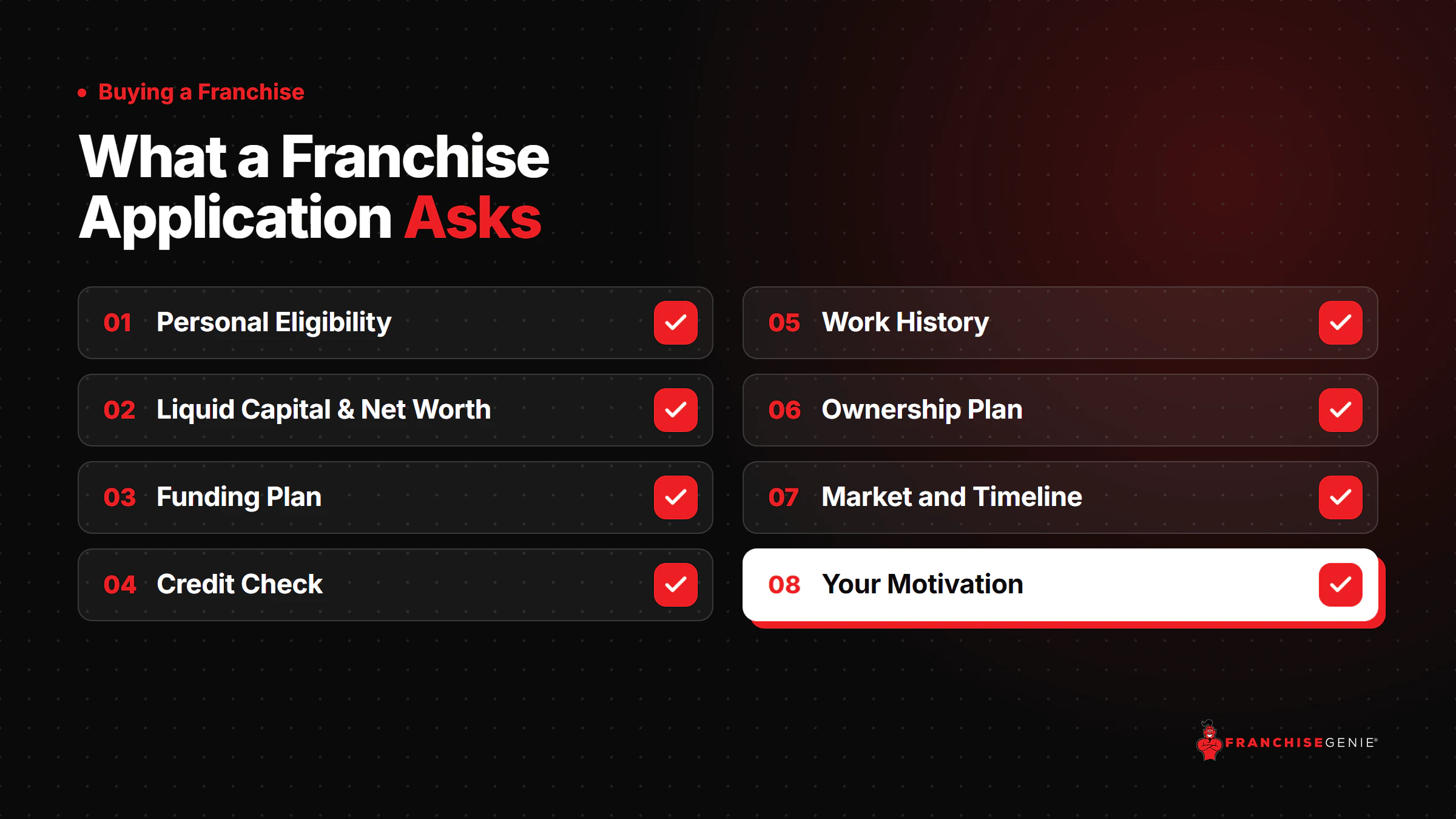
- Expect questions about liquid capital, net worth, credit, funding sources, work history, target market, and timeline.
- Franchisors typically verify finances through a personal financial statement, a credit check, and later through bank statements and lender documentation.
- Completing an application does not obligate you to buy, and you should never pay a franchisor any money before you have had the FDD for at least 14 calendar days.
A franchise application is a screening questionnaire franchisors use to decide whether you qualify to move forward. It typically asks about your liquid capital, net worth, credit, funding plans, work history, preferred market, and timeline. It is not binding. Its job is to confirm both sides should keep talking before the franchisor shares the full disclosure document and invests time in you.
Buyers sometimes treat the application as paperwork to get through. It is better understood as the franchisor’s first real look at you, and your first chance to see how seriously the franchisor screens owners. A brand that will accept anyone with a check is a brand whose other franchisees were also accepted that way.
This article covers what franchisors ask, how they verify it, and how to present yourself well. For where the application fits in the larger process, see our guide on how to buy a franchise.
What is a franchise application?
Different franchisors call it different things: a request for consideration, a confidential questionnaire, a candidate profile, or simply an application. The format ranges from a short online form to a multi-page document with a personal financial statement attached.
It usually arrives after one or two introductory calls with a franchise development representative. Some franchisors send the Franchise Disclosure Document before the application. Many send it shortly after, once they confirm you meet basic financial requirements.
Completing the application does not obligate you to anything. Under the FTC Franchise Rule, you cannot be required to sign a binding agreement or pay the franchisor any money until you have had the FDD for at least 14 calendar days. If a franchisor asks for a fee with the application, ask what it covers and whether it is refundable, and check the timing against that rule.
What does a franchise application ask?
Most applications cover the same core areas.
| Section | Typical questions | What the franchisor is checking |
|---|---|---|
| Personal information | Name, contact details, citizenship or visa status | Basic eligibility |
| Financial profile | Liquid capital, net worth, assets and liabilities | Whether you can fund the investment and survive the ramp-up |
| Funding plan | Cash, SBA loan, ROBS, home equity, partners | Whether your financing plan is realistic |
| Credit | Permission for a credit check, past bankruptcies or judgments | Your ability to secure loans and manage obligations |
| Work history | Roles, industries, management experience | Transferable skills and leadership ability |
| Ownership plan | Owner-operator or semi-absentee, partners, number of units | Fit with the franchisor’s model |
| Market | Preferred city or territory | Availability and market potential |
| Timeline | When you want to sign and open | Seriousness and alignment with their pipeline |
| Motivation | Why franchising, why this brand | Commitment and realistic expectations |
| Legal | Litigation, criminal history, non-compete obligations | Risks that could affect your ability to operate |
Some applications also ask for references, a résumé, or a short written statement about your goals.
How franchisors verify your finances
Financial qualification is the first filter. Franchisors set minimum liquid capital and net worth requirements because undercapitalized owners are more likely to struggle.
The personal financial statement
Many franchisors ask for a personal financial statement listing your assets and liabilities. Lenders use a similar form, so preparing one carefully now saves time later. Include cash accounts, investments, retirement accounts, real estate equity, and all debts.
Credit checks
Many franchisors run a credit check with your permission. Most buyers rely on some financing, and lenders will scrutinize credit closely. If you have a past issue such as a bankruptcy, medical debt, or a late-payment period, explain it in writing before the franchisor finds it.
Proof of funds
Later in the process, often before signing, franchisors may ask for bank or brokerage statements, a lender pre-approval, or documentation of a ROBS or home equity plan. Expect them to confirm what you stated on the application.
How liquidity is counted
Liquid capital usually means cash and assets you can access quickly. Retirement funds are a gray area. Some franchisors count them if you plan to use a rollover as business startup structure, and others do not. Ask how they count each asset before you assume you qualify.
What franchisors look for beyond money
Meeting the financial minimum gets you in the door. Franchisors make the final decision on fit, and they look for several things.
Willingness to follow a system. Franchising rewards people who execute a proven playbook. Applicants who describe big plans to change the concept tend to worry franchisors.
Relevant skills. Sales, people management, and operations experience transfer well to most models. Industry experience is helpful in some systems and irrelevant in others.
Realistic expectations. Franchisors notice when an applicant expects fast profits or a light workload in an owner-operator model.
Commitment and timeline. A clear, credible timeline signals seriousness.
Local knowledge. Familiarity with your target market, its customers, and its business community counts for a lot in service businesses that rely on local relationships.
Coachability. How you respond to their questions and feedback during the process shows how you will respond to field support after opening.
How to stand out on a franchise application
You do not need a perfect résumé. You need a clear, honest, well-organized one.
- Be accurate about money. Overstating liquidity only delays a painful conversation. Franchisors and lenders will verify it.
- Prepare your financial documents in advance. A completed personal financial statement and recent account statements make you look organized and speed up approval.
- Know your owner style. Say clearly whether you plan to run the business day to day or hire a manager. That helps the franchisor tell you honestly whether you fit.
- Explain your motivation in specifics. “I managed a team of 30 in logistics and want to apply that to a business I own” is stronger than “I’ve always wanted to be my own boss.”
- Address weak spots directly. If you lack management experience or have a credit blemish, say so and explain how you will handle it.
- Ask good questions back. The application stage is a good time to ask how the franchisor selects owners and how many applicants it declines.
The application is a two-way filter
Pay attention to how a franchisor handles your application. A thorough screening process, with real questions about your experience and finances, is a healthy sign. It suggests the franchisor protects its system by choosing owners carefully.
Be wary of a franchisor that skips qualification, approves you after a single short call, or seems more interested in your check than your background. The FTC’s Consumer’s Guide to Buying a Franchise recommends looking carefully at how franchisors sell, since aggressive sales practices often reflect how a system is run.
Use what you learn during the application stage to compare franchises on more than their marketing. How a brand qualifies you is one of the few windows into how it treats franchisees.
What comes after approval
Once a franchisor is satisfied with your application, the process usually continues with:
- Receipt and review of the full franchise disclosure document.
- Calls with department heads and validation calls with current and former franchisees.
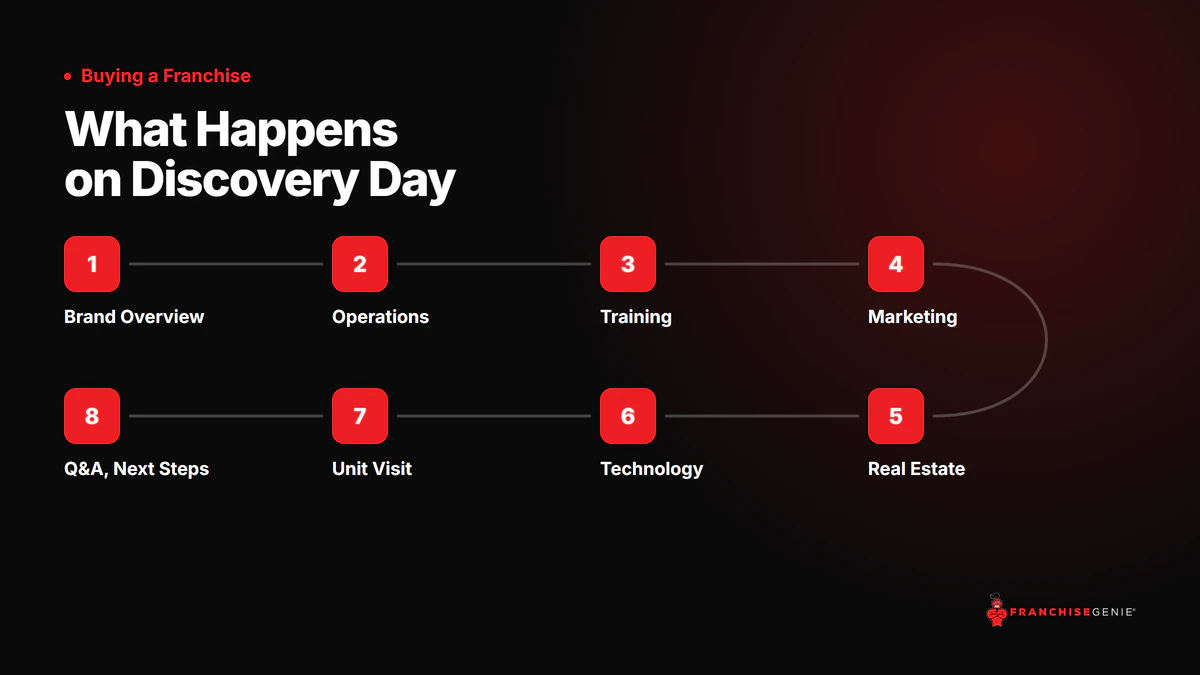
- Discovery day at headquarters.
- Final approval, followed by legal review of the franchise agreement.
If there are points you want to discuss, this is when you might negotiate a franchise agreement with the help of a franchise attorney. Financing usually runs in parallel. The SBA’s guide to buying a business or franchise is a helpful overview of loan options and documentation lenders expect.
Prepare before you apply
The strongest applications come from buyers who already know their budget, their preferred level of involvement, and the kind of business that suits them. If you are not there yet, take the free Franchise Genie assessment. It gives you an owner archetype and three industry categories that fit your answers, which makes every application you fill out more focused and more credible.
Frequently Asked Questions
Is a franchise application binding?
No. A franchise application, sometimes called a request for consideration or confidential questionnaire, is a screening form. It lets the franchisor decide whether to continue the conversation and provide the Franchise Disclosure Document. It does not commit you to buy, and it does not commit the franchisor to award you a franchise. The binding document is the franchise agreement, which you sign much later.
Does a franchise application require a credit check?
Many do. Franchisors often ask for permission to run a credit check because most buyers use some financing, and lenders will look closely at your credit history. A soft inquiry does not usually affect your score, but ask which type they run. If you have past credit problems, explain them up front. A clear explanation is better received than a surprise.
What is the difference between liquid capital and net worth on a franchise application?
Liquid capital is cash or assets you can convert to cash quickly, such as checking, savings, and brokerage accounts. Net worth is total assets minus total liabilities, including home equity and retirement accounts. Franchisors set minimums for both. Liquid capital matters most because it funds your down payment and working capital. Retirement funds may count toward liquidity in some cases if you plan to use a ROBS structure.
What happens after I submit a franchise application?
The franchise development team reviews it, often within a few days, and schedules a follow-up call. If you meet their criteria, they typically send the Franchise Disclosure Document and outline next steps, such as calls with department heads, validation with franchisees, and discovery day. If you don't qualify, a good franchisor will tell you why, which is useful information in itself.