Key Takeaways
- You can sometimes negotiate a franchise agreement, but core economic terms like the royalty rate and marketing fund contribution are rarely changed for a single-unit buyer.
- Terms more often open to discussion include opening deadlines, development schedules, territory boundaries, fee timing, and certain transfer and personal guarantee provisions.
- Multi-unit buyers, experienced operators, and buyers in newer franchise systems generally have more room to negotiate.
- Any negotiated change should be written into the franchise agreement or a signed addendum, because verbal promises are usually not enforceable.
- Work through a franchise attorney, prioritize two or three requests, and explain the business reason behind each one.
Yes, you can sometimes negotiate a franchise agreement, but less than most buyers expect. Franchisors keep core terms such as the royalty rate, marketing fund contribution, and operating standards uniform across the system. Deal-specific terms are more flexible, including opening deadlines, development schedules, territory boundaries, fee timing, and some transfer and guarantee provisions. Your bargaining power grows if you are buying multiple units or joining a newer system.
The franchise agreement is the longest-lasting document in the whole purchase. It typically runs 10 years and controls your fees, territory, renewal rights, and how you can leave. Even if you change nothing, you should understand every clause. If you change one or two things that matter to your situation, that is a meaningful win.
This article covers why franchisors resist changes, which terms are commonly open, and how to ask. It fits within the larger sequence of steps in our guide to how to buy a franchise.
Why franchise agreements are hard to change
A franchise system works because every unit follows the same rules. If one franchisee pays a lower royalty or gets a looser territory, others will ask why they can’t have the same. Consistency also makes the franchisor’s agreements easier to enforce.
There is a regulatory reason, too. The FTC Franchise Rule requires franchisors to disclose their standard terms in the Franchise Disclosure Document. If a franchisor unilaterally changes material terms of the agreement for you, you must receive the final version at least 7 calendar days before signing. Some registration states have their own rules about disclosing negotiated changes. None of this prevents negotiation, but it makes franchisors cautious.
What terms can you negotiate in a franchise agreement?
Flexibility varies by brand, but these patterns hold across much of the industry.
| Term | How often it is negotiable | Notes |
|---|---|---|
| Royalty rate | Rarely | Sometimes a temporary ramp-up for early units or multi-unit deals |
| Marketing fund contribution | Rarely | Usually fixed system-wide |
| Initial franchise fee | Occasionally | Discounts for multi-unit, veterans, conversions; deferral more common than reduction |
| Opening deadline | Often | Especially when real estate or permits are slow in your market |
| Development schedule (multi-unit) | Often | Number of units and timing can be adjusted |
| Territory boundaries | Sometimes | Clarifying definitions is easier than expanding size |
| Right of first refusal on nearby territory | Sometimes | More common for multi-unit buyers |
| Personal guarantee | Sometimes | Caps or limits may be possible, rarely full removal |
| Transfer fee and conditions | Sometimes | Transfers to family or your own entity are a common ask |
| Non-compete scope | Sometimes | Geographic radius or duration may be adjusted, subject to state law |
| Required remodel timing | Occasionally | Particularly if you are buying an existing unit |
| Operating standards and brand rules | Almost never | These protect the brand system-wide |
Your franchise attorney will know how a given franchisor typically responds. Some brands publish a firm policy of making no changes. Others expect a short addendum from nearly every buyer.
Who has the most room to negotiate?
Bargaining power in franchise negotiations comes from what you bring to the system.
Multi-unit buyers. Committing to develop three or five units is worth more to a franchisor than a single store, and terms like the development schedule, fee per unit, and territory rights are often adjusted.
Experienced operators. Someone who already runs franchises successfully, in the same system or a similar one, lowers the franchisor’s risk.
Buyers in newer systems. An emerging franchisor with a small number of units may be more willing to adjust terms to attract strong early franchisees. It may also have less support infrastructure, so weigh that tradeoff.
Buyers of hard-to-sell territories. A market the franchisor has struggled to fill may come with more flexibility.
Conversion franchisees. Owners bringing an existing independent business into a system often negotiate fee and remodel terms.
A first-time single-unit buyer in a large, established system has the least bargaining power. That is fine. Clarifying ambiguous terms is still worthwhile even if economic terms stay fixed.
How to negotiate a franchise agreement, step by step
The process matters as much as the request.
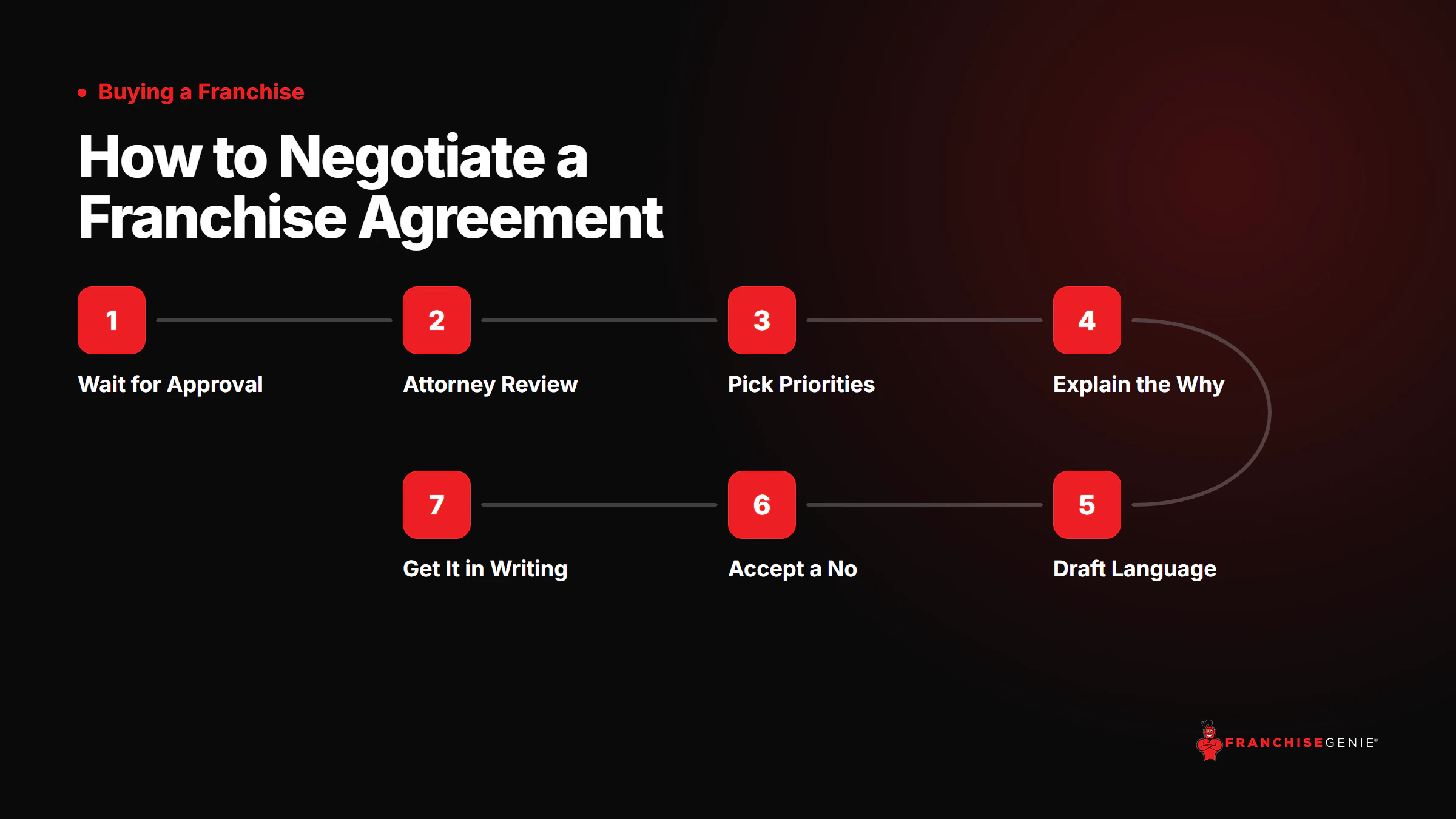
- Wait until you have been approved. Most franchisors make an approval decision after the franchise application and discovery day. Negotiating before that point is premature.
- Have a franchise attorney review the agreement. Ask them to flag anything unusual and to tell you which points are worth raising.
- Pick two or three priorities. A long list of minor requests signals that you will be a difficult franchisee. Focus on what affects your business most.
- Explain the business reason. “My market’s permitting timeline averages nine months, so I need a 15-month opening deadline” is persuasive. “I’d like more time” is not.
- Propose specific language. Let your attorney draft the change. Franchisors respond faster to a concrete proposal than an open-ended request.
- Accept a no gracefully. If the franchisor refuses a reasonable request, note how they handled it. That tells you something about the relationship.
- Get it in writing. Any agreed change belongs in the franchise agreement or a signed addendum. A verbal assurance from a sales rep is not enough.
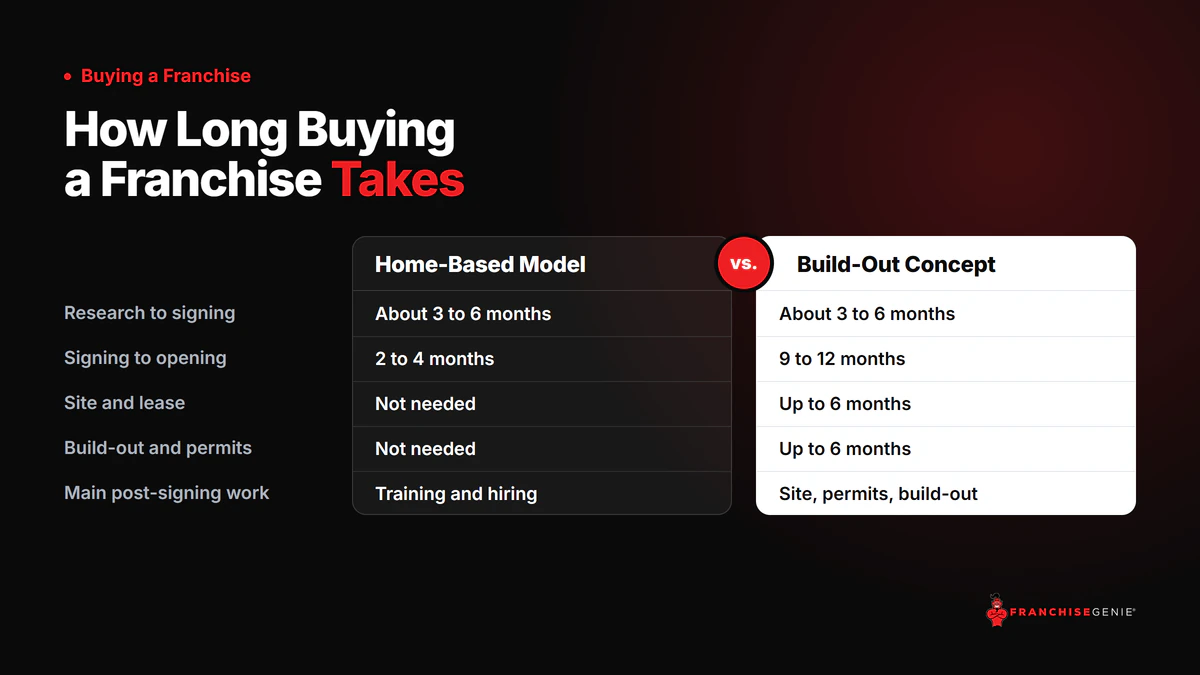
Negotiation adds time, often one to three weeks. Factor that into your plans if you are tracking how long it takes to buy a franchise.
Examples of reasonable requests
These are illustrations, not recommendations for your specific deal. Your attorney should advise on your situation.
- Opening deadline extension. Asking for 15 or 18 months to open instead of 12 in a market with slow permitting.
- Territory clarification. Defining your territory by a specific list of zip codes on a map attached to the agreement, rather than a general description.
- Transfer to your own entity. Confirming that moving the franchise into an LLC you control, or transferring to a spouse or child, will not trigger a full transfer fee.
- Fee timing. Paying part of the initial fee at signing and the rest at opening.
- Personal guarantee limits. Asking whether the guarantee can be limited in amount or to the period before opening, though many franchisors will not agree.
- Development schedule flexibility. For multi-unit deals, adding time between required openings.
A hypothetical example
Consider a hypothetical buyer, Priya, who is signing a three-unit development agreement for a fitness concept. Her attorney flags that the agreement requires all three units to open within 30 months. Priya’s market has limited available retail space, so she asks for 42 months, citing local vacancy data and her own lease timeline for unit one. The franchisor agrees to 36 months with a 6-month extension available if she has a signed lease in progress. Neither side got everything, and Priya has a schedule she can realistically meet.
Negotiating financing-related terms
Some franchisors offer their own financing or fee deferrals. If your brand does, the terms of that financing are often more flexible than the franchise agreement itself. Our guide to franchisor financing covers how these programs work and what to compare.
Separately, you will negotiate with lenders on loan terms, collateral, and guarantees. That process is independent of the franchisor. Our cornerstone on how to finance a franchise explains the main options. The SBA’s overview of buying a business or franchise is also a useful reference. Always involve a CPA or lender for advice on your specific situation.
What not to do
- Don’t rely on side promises. If something matters, it must be in the signed documents.
- Don’t negotiate the brand standards. Requests to change how you operate within the system will mark you as a poor fit.
- Don’t skip legal review because terms are “non-negotiable.” Understanding the agreement is valuable even if you change nothing.
- Don’t let negotiation replace due diligence. A better contract does not fix a business that is wrong for you.
The FTC’s Consumer’s Guide to Buying a Franchise reinforces the same point: understand what you are signing before you sign it.
Start with fit, then focus on terms
The most valuable negotiation happens before you ever see a franchise agreement, when you decide which kind of business is right for you. Contract terms matter, but no addendum fixes a model that doesn’t suit your budget, schedule, or goals.
If you are still deciding where to look, take the free Franchise Genie assessment. In a few minutes, you’ll get an owner archetype and three industry categories matched to your answers, so the agreements you eventually review are for businesses worth negotiating over.
Frequently Asked Questions
Can you negotiate the franchise fee?
Occasionally. Many franchisors keep the initial fee uniform for all buyers, and some states require that any variations be disclosed. Discounts are more common for multi-unit commitments, veterans in systems that offer veteran incentives, existing franchisees, or conversions of an independent business. Asking to defer part of the fee until opening is sometimes more achievable than asking to reduce it.
Why won't franchisors change their franchise agreement?
Franchisors keep agreements consistent so every franchisee operates under the same rules, which makes the system easier to manage and enforce. Changing terms for one buyer can create fairness complaints from others and, in some registration states, may require disclosure or filing. That is why franchisors are usually firmer on fees and operating standards and more flexible on deal-specific details like timelines and territory boundaries.
Will negotiating hurt my chances of being approved?
Reasonable, well-prepared requests rarely hurt a strong candidate. Franchisors expect serious buyers to involve attorneys and raise questions. What can damage the relationship is demanding changes to core terms, arguing over many minor points, or negotiating aggressively before you have even been approved. Pick a few requests that matter, explain why, and accept a polite no on terms the franchisor treats as standard.
Do I need a franchise attorney to negotiate?
It is strongly recommended. A franchise attorney knows which terms franchisors commonly adjust, how to word a request, and how to document changes in an addendum so they are enforceable. They can also explain the consequences of terms you might otherwise accept without thinking. The cost of legal review is small relative to a 10-year contract that governs your investment.