Key Takeaways
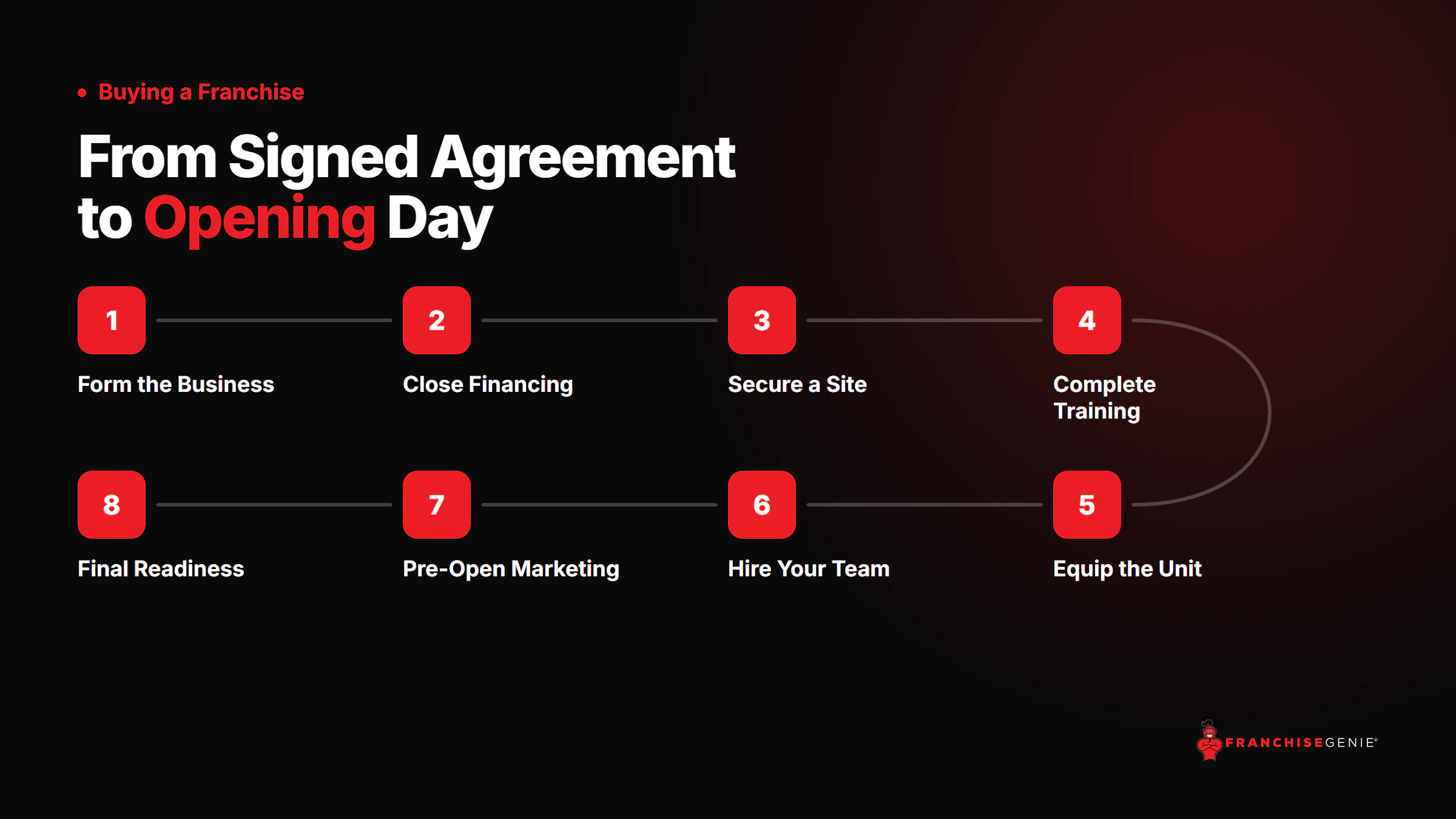
- After signing a franchise agreement, the main tasks are forming your entity, closing financing, securing and building out a site if needed, completing training, hiring staff, and running pre-opening marketing.
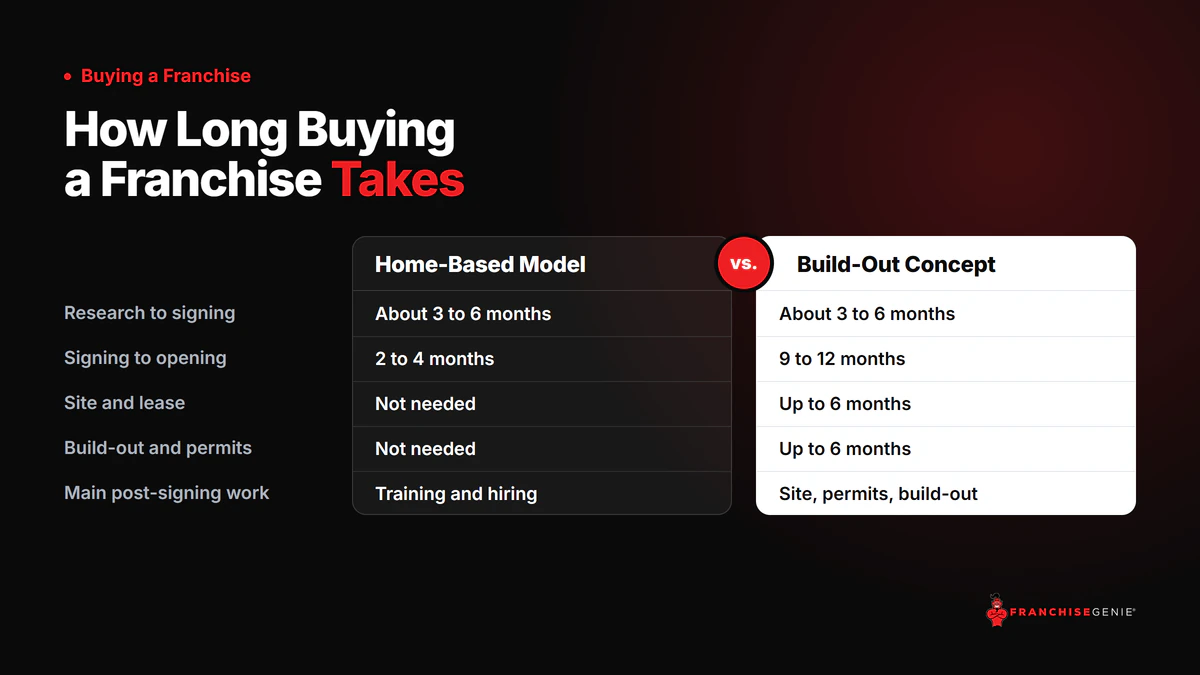
- The time from signing to opening commonly ranges from 2 to 4 months for home-based service models to 9 to 12 months or more for build-out concepts.
- Most franchise agreements set an opening deadline, so build a written timeline with a buffer and track it weekly.
- Assemble your professional team early, including a CPA, a franchise attorney, a commercial insurance agent, and for storefront models a real estate broker and contractor.
- Protect your working capital during pre-opening, since delays and early operating losses are common.
After signing a franchise agreement, your work shifts from deciding to building. The main tasks are forming your business entity, closing financing, securing a site if you need one, completing training, setting up systems, hiring your team, and running pre-opening marketing. Home-based service franchises often open in 2 to 4 months. Build-out concepts like food or fitness commonly take 9 to 12 months or more.
The months between signing and opening are busy and expensive. You are spending money before any revenue arrives, coordinating contractors, lenders, landlords, and the franchisor, and often still working your current job. A clear checklist keeps you on schedule and protects your working capital.
This guide lays out what to do and in what order. For the steps that lead up to signing, see our guide on how to buy a franchise.
What happens right after signing a franchise agreement?
In the first few weeks, your franchisor will usually assign an onboarding or opening coordinator, give you access to its operations manual and online systems, and share a pre-opening timeline. You will typically pay the initial franchise fee at signing.
Read the timeline carefully and compare it to the deadlines in your franchise agreement. Many agreements require you to secure a site within a set number of days and open within a set number of months. Missing these can have real consequences, so confirm them with your franchise attorney.
Your pre-opening checklist
Not every step applies to every model. Use this as a master list and remove what doesn’t fit.
Phase 1: Set up the business (weeks 1 to 4)
- Form your legal entity, typically an LLC or corporation, with guidance from your attorney and CPA.
- Obtain an Employer Identification Number (EIN) from the IRS.
- Open business bank accounts and keep personal and business funds separate.
- Assign the franchise agreement to your entity if the agreement permits and the franchisor approves.
- Engage a CPA familiar with franchises to set up bookkeeping and payroll.
- Get quotes for the insurance coverage your franchise agreement requires.
- Research state and local business licenses and any industry-specific permits.
Phase 2: Close financing (weeks 2 to 10)
- Provide lenders with your signed franchise agreement and any requested documents.
- Close your SBA loan, conventional loan, ROBS structure, or other funding.
- Confirm how and when funds will be disbursed for build-out, equipment, and working capital.
- Set up a cash flow plan covering pre-opening costs and the first months of operation.
Financing often depends on a signed lease for storefront models, so phases 2 and 3 tend to overlap.
Phase 3: Secure and prepare your location (weeks 2 to 30)
For storefront concepts, this is usually the longest phase.
- Work with a tenant-side commercial broker to identify sites that meet the franchisor’s criteria.
- Submit sites for franchisor approval.
- Negotiate the lease with contingencies for approval, financing, and permits.
- Have a real estate attorney review the lease.
- Hire an architect and contractor, often from the franchisor’s approved list.
- Apply for building permits.
- Complete build-out, signage, and inspections.
For home-based models, this phase may only involve setting up a home office, leasing storage, and buying vehicles.
Phase 4: Train (timing varies)
- Complete any online pre-work.
- Attend initial franchise training at headquarters or a training center.
- Complete in-unit training in an operating location.
- Arrange training for your general manager if your model uses one.
Phase 5: Equip and set up systems (4 to 8 weeks before opening)
- Order equipment, furniture, and fixtures from approved vendors.
- Set up point of sale, scheduling, CRM, and reporting software.
- Order opening inventory and supplies.
- Set up phone, internet, and the franchisor’s email and communication tools.
Phase 6: Hire your team (4 to 8 weeks before opening)
- Write job descriptions using the franchisor’s templates.
- Post jobs and run interviews.
- Complete background checks where required.
- Set up payroll and onboarding paperwork.
- Train staff, often with support from the franchisor’s opening team.
Phase 7: Pre-opening marketing (6 to 12 weeks before opening)
- Set up your local listings, website page, and social media through the franchisor’s systems.
- Plan your grand opening with the franchisor’s marketing team.
- Start pre-sales, memberships, or lead generation if your model allows.
- Connect with local business groups, chambers of commerce, and community organizations.
Phase 8: Final readiness (last 2 weeks)
- Pass final inspections and obtain your certificate of occupancy if needed.
- Complete the franchisor’s opening approval checklist.
- Run soft openings or practice days with friends and family.
- Confirm your opening support team’s dates.
Typical timeline after signing a franchise agreement
| Model | Typical signing-to-opening range | Main time drivers |
|---|---|---|
| Home-based or mobile services | 2 to 4 months | Training, licensing, vehicles, hiring |
| Office-based B2B services | 3 to 6 months | Office lease, hiring, early sales |
| Small retail or personal services | 4 to 8 months | Lease, light build-out |
| Fitness and wellness | 6 to 12 months | Site, build-out, equipment, pre-sales |
| Food and beverage | 9 to 12 months or more | Site, build-out, permits, equipment, inspections |
These are general ranges. Your franchisor’s records and conversations with recent franchisees will give you a better estimate for your market.
Who should be on your team?
Most new owners need several outside professionals during pre-opening:
- Franchise attorney. For questions about the agreement, entity assignment, and franchisor approvals.
- Real estate attorney. For lease review, if your model needs a location.
- CPA. For entity choice, payroll setup, tax registration, and cash flow planning.
- Lender. To close and disburse financing.
- Insurance agent. For general liability, property, workers’ compensation, and any coverage your agreement requires.
- Commercial broker and contractor. For storefront models.
Choose these people early. Delays often come from waiting on a professional who was hired too late.
Common mistakes after signing
- Spending working capital on build-out overruns. Get firm contractor bids and keep a contingency separate from your operating reserve.
- Treating the opening deadline as a target rather than a limit. Plan to open before it, with a buffer.
- Hiring too late. Good staff take time to find, and training them takes more.
- Skipping local marketing until opening week. Customers need to know you exist before the doors open.
- Ignoring fee start dates. Some fees can begin before you open. Check Item 6 and your agreement.
Keep your due diligence documents close
Your franchise disclosure document remains useful after signing. Item 11 describes what the franchisor promised to provide before opening, such as site assistance and training. Item 8 covers required vendors. If something seems to fall short, compare it to the FDD and your agreement before raising it.
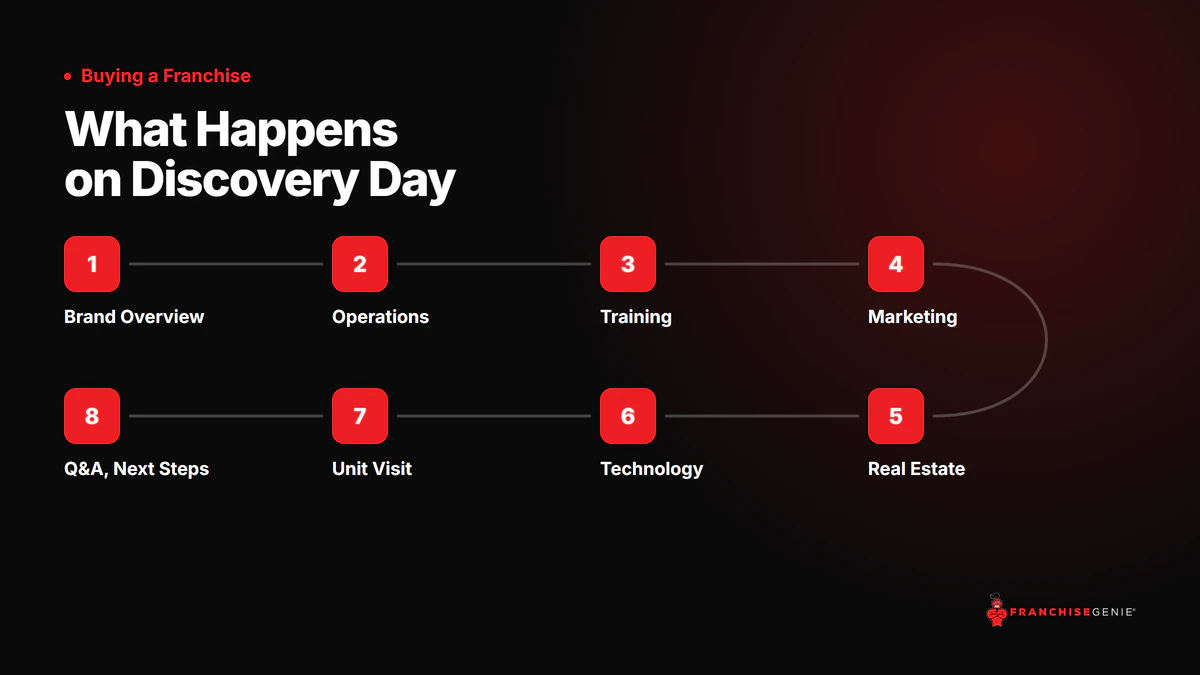
Your notes from franchise discovery day and validation calls are useful, too. The franchisees you spoke with during research can become your first peer network. If you used a franchise due diligence checklist during your research, keep it with your pre-opening plan as a reference for what you were told.
The FTC’s Consumer’s Guide to Buying a Franchise and the SBA’s guide to buying a business or franchise are both useful refreshers during this phase, particularly on financing and franchisor obligations.
If you haven’t signed yet
Reading about pre-opening is a good reality check before you commit. If the timeline, the coordination, or the cash needed before opening feel like a poor match for your situation, a different model may fit better. Take the free Franchise Genie assessment to see your owner archetype and three industry categories matched to your budget, schedule, and goals. It takes a few minutes and helps you choose a business whose path to opening day fits the life you have.
Frequently Asked Questions
How soon after signing a franchise agreement can I open?
It depends mostly on whether you need real estate. Home-based and mobile service franchises often open 2 to 4 months after signing. Small office or retail concepts commonly take 4 to 8 months. Food, fitness, and other build-out concepts frequently take 9 to 12 months or longer, with site selection, lease negotiation, and permitting causing most of the variation. Ask the franchisor for recent opening timelines in markets like yours.
Can I back out after signing a franchise agreement?
Generally, a signed franchise agreement is a binding contract, and leaving it can mean losing your initial franchise fee and facing other obligations. Some agreements include limited refund provisions if, for example, you fail to complete training or the franchisor doesn't approve a site. Talk to your franchise attorney about your agreement's terms before making any decision.
When do I start paying royalties after signing?
Most franchisors start royalties when you open for business and begin generating revenue, not at signing. Some charge minimum royalties or technology fees after a set period, even if you haven't opened. Your franchise agreement and Item 6 of the Franchise Disclosure Document describe when each ongoing fee begins. Check this carefully, because opening delays can trigger fees before revenue starts.
Should I quit my job right after signing?
Not necessarily. Many owners keep working until training starts or until the business needs them full time. The right timing depends on whether the model is owner-operated, how long pre-opening will take, and how much personal income your working capital can cover. Map your household cash needs month by month with a CPA before you give notice.